
Biomechanics vs. Anatomy: What Makes You a Better Yoga Teacher
I sit in Malasana with my feet wider than almost every student in the room. You might think that means something is wrong with my hips, or that I just need more practice.
It isn't a hip problem, and figuring that out took a lot more than knowing anatomy.
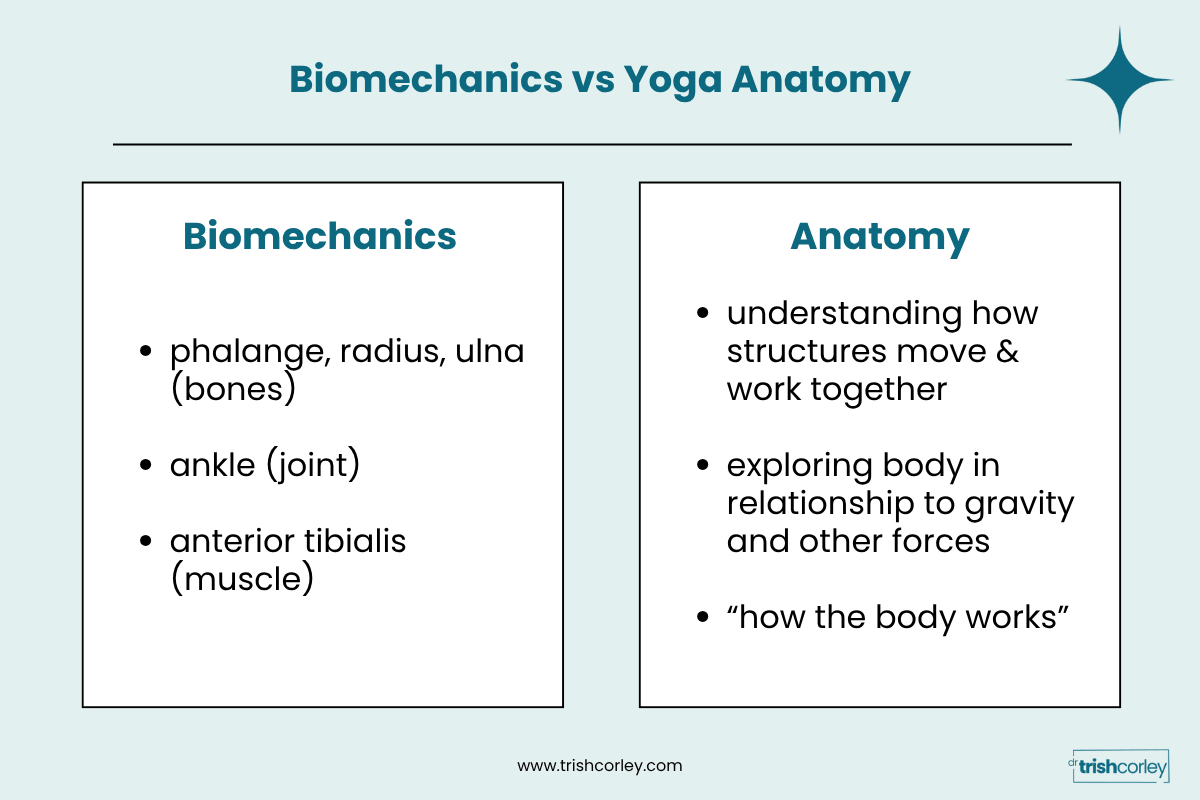
You hear me use the word anatomy constantly. It's the word yoga teachers know, so it's the word I reach for. However, anatomy on its own is really just the naming of structures. Learning it is closer to a memory game than a skill: point to something, know what it's called. Point to a finger bone and identify it as a “phalange”. Point to the bones in your forearm. They are the radius and ulna. Some people like this game. And I know a lot of yoga teachers don’t. Either way, playing this game doesn’t make you a better yoga teacher.
Knowing the name of a structure has never told me what to do about it. Understanding how that structure moves, works with the structures around it, and responds to gravity, is what allows me to actually help students. And that understanding is not just “anatomy”. That's biomechanics, and it's the difference that actually makes you a better teacher.
In This Article:
Why anatomy is a naming game, not a teaching skill
What biomechanics actually means, and why it's the more useful lens
How this plays out in my own Malasana, as one concrete example
What this changes about the way you cue
Anatomy Names Structures. Biomechanics Explains What They Do.
Anatomy is the vocabulary. It's useful for communicating precisely, the same way doctors and physical therapists use it to communicate with each other. Naming a structure doesn't tell you how it behaves, what limits it, or what to do when it's the reason a posture isn't working the way you expect.
Biomechanics is the layer underneath the vocabulary: how those structures move, how they work in relationship to each other, and how they respond to gravity while a person is practicing asana (or simply moving on this Earth). That's the layer that actually explains what's happening in front of you, and it's the layer that lets you respond to it.
Here's What That Looks Like: My Own Malasana
I don't need the word dorsiflexion to understand my own squat. I need to understand what my ankle is doing.
Dorsiflexion is simply the motion of the toes lifting toward the shin. In my own ankles, due to the structure of my bones, that range is fairly limited. When I bring my feet narrow and turned in, my shin runs out of room to tip forward over my foot, and I hit a hard stop about halfway down. I feel like I am falling backwards, and often do have to take a step back to catch myself. That's not my hips. It's not a strength issue. It's a structural limit at the joint, and no amount of stretching changes the shape of a bone.
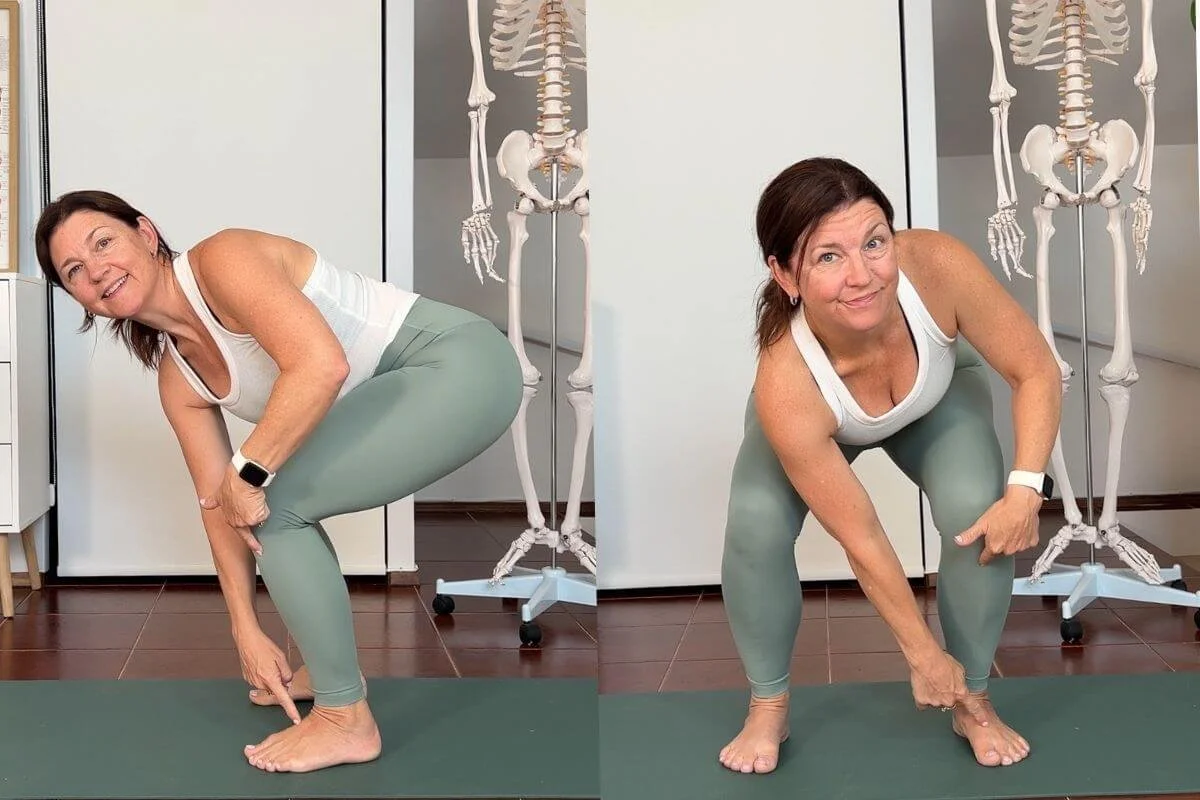
When I widen my stance and turn my feet out further, I get more range through my hips and knees while working with that same ankle limit, and I can drop into the full squat. The wider stance and external rotation of my hips helps me compensate for the lack of ankle movement, and I don’t feel like I will fall backwards. I feel the expected pressure at my ankle and a good stretching sensation through my hips. That’s exactly what I'm there for.
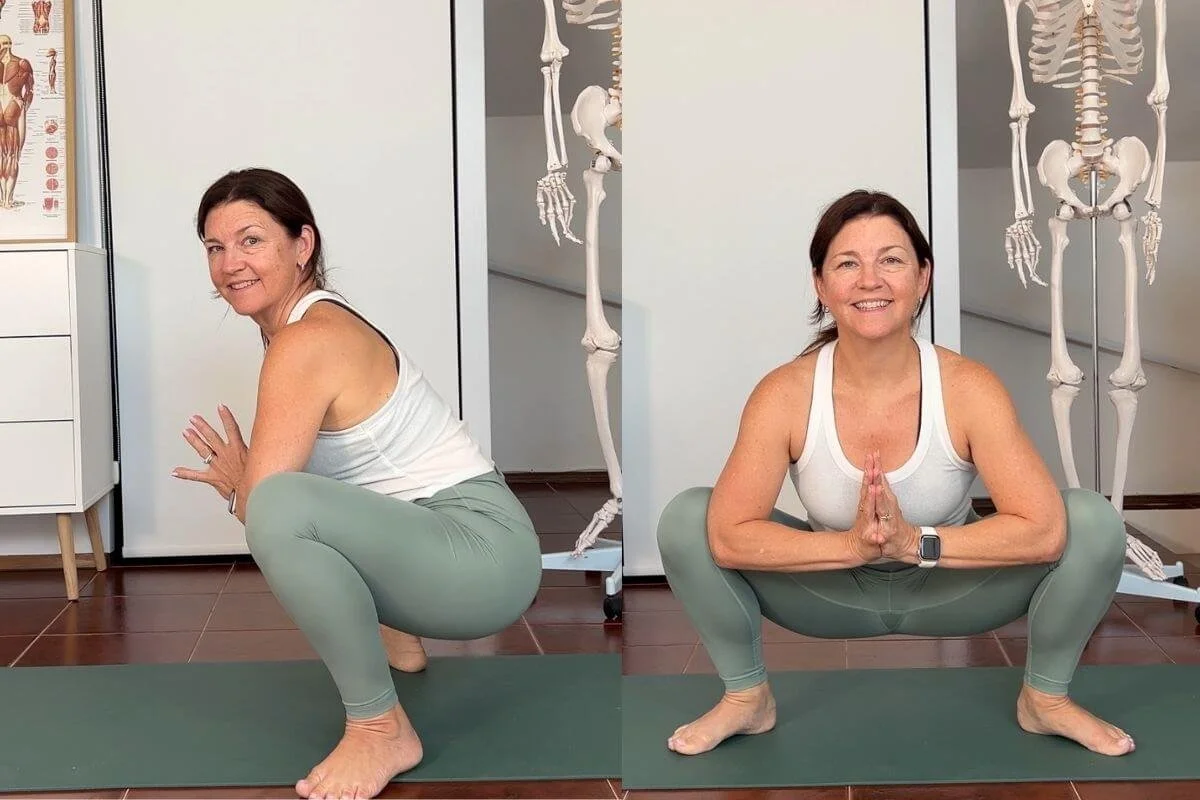
Notice that naming the bones and even the word “dorsiflexion” are not what helped me modify the posture. It’s the understanding of why limited ankle dorsiflexion stops me in Malasana that gets me thinking about ways to modify the posture to make it work.
The same ankle mechanics show up elsewhere too Limited ankle dorsiflexion may also contribute to why your heels might not touch the ground in Downward Dog
What This Changes About the Way You Teach
This is the actual point, and Malasana is just the example that happened to make it obvious to me.
A student whose posture "isn't working" probably has some limitation in their anatomy. Often, one joint has reached its available range, and the rest of the body is looking for a way to complete the shape anyway, by lifting a heel, rounding a spine, or stopping short. You can keep trying to learn anatomy and name all the structures in the body, but anatomy vocabulary won't tell you which joint, or what to offer instead. Understanding how the structures work together will.
That's the shift yoga teachers need: to go from reciting what things are called, to understanding what's actually happening and responding to it.
Check out my YouTube video for a more visual explanation.
Stop Memorizing. Start Learning.
It can be helpful to memorize some things so that you just have them easily at hand. And if you want to use what you memorize to actually teach impactful yoga, you will need to understand how the anatomy works. You need to learn the why behind your cues. That is the first action towards really being able to help your students.
The Bottom Line
My own Malasana was never solved by a vocabulary word. It was solved by understanding why my ankle stopped moving and what that meant for the rest of the shape. That's the pattern behind every stuck posture: something structural is happening, and biomechanics is the lens that shows you what it is.
Get Curious! Q&A
What's the actual difference between anatomy and biomechanics?
Anatomy is the naming of structures, like calling a bone a tibia or a joint an ankle. Biomechanics is understanding how those structures move, how they work together, and how they respond to gravity. Yoga teachers need to understand biomechanics far more than they need the vocabulary.
Why doesn't knowing anatomy terms make someone a better yoga teacher?
Knowing a structure's name doesn't tell you how it moves, what limits it, or what to offer when a posture isn't working. That information comes from understanding the mechanics, not the labels.
How do I decide whether to modify a posture like Malasana?
Start by identifying what's actually limiting the shape. A stuck squat is often assumed to be hip tightness. Look beyond though and you may discover it's the ankle reaching the end of its structural range for dorsiflexion. You need to know which joint is the limiting factor in order to know what modifications will work.
Is a structural limit something a student can stretch away?
Some restriction is soft tissue and can shift over time with consistent practice. Some restriction comes from the shape of the bones meeting at a joint, and it is very unlikely to change in an adult. Understanding which one you're looking at changes what you cue.
How do I start thinking in biomechanics instead of just anatomy?
Start by watching what's actually happening in a posture rather than reaching for the nearest anatomy term or generic cue. Ask what a joint is doing, what's limiting it, and how gravity and the rest of the body are responding. That habit of observation is the whole shift!
Go Deeper with the biomechanics behind every cue you teach
Malasana was one example. The same pattern, a joint has a structural range, gravity changes what's actually happening, and the answer is rarely "try harder," shows up across nearly every posture you teach. This is the exact shift I teach yoga teachers how to make: from naming anatomy to understanding biomechanics, so you can adapt in the moment instead of leaning on a script.
Download my free guide: Cue with Confidence →
Get anatomy-informed cues you can take into your next class. This guide is also preview of how I teach inside the Enlightened Anatomy Course.
About the Author
Dr. Trish Corley is a Doctor of Physical Therapy (Physiotherapist) and yoga teacher trainer with over two decades of clinical experience. She helps yoga teachers learn anatomy, give clear cues, and create classes their students love. Based in Lisbon, Portugal, she leads the Enlightened Anatomy Course, the Elevate Your Impact Mentorship, and the Power to Lead 200-Hour YTT.