
Effective Yoga Cues: The 3-Part Formula for Clear, Confident Teaching
You're mid-flow, guiding your class through a transition, and you sense it. That slight hesitation. A few confused glances. Someone stepping the wrong foot forward.
You keep teaching, but inside you're full of doubt. Did that cue make sense? Why do I always fumble this part? What the heck am I doing here?
The problem isn't you. It's how you're structuring your cues.
Did you know there is actually a simple formula for this?
The most effective yoga cues follow a simple 3-part formula: action + body part + direction. This structure eliminates confusion, builds student trust, and gives you a reliable framework so you're not reinventing the wheel every time you open your mouth.
I've taught this formula to hundreds of yoga teachers over my 20+ years as a doctor of physical therapy, anatomy professor, and yoga teacher trainer. It works because it's how humans are wired to receive instructions.
In This Article:
Why confusion kills confidence (for you AND your students)
The 3-part action cue formula
Examples of effective vs. ineffective cues
How specificity creates presence
Why Your Cues Might Not Be Landing
Have you noticed that the most effective yoga teachers often say the least? They're clear, concise, and focused.
Meanwhile, many teachers talk more when they feel uncertain, adding filler words and roundabout explanations that only create more confusion.
Here's the cycle: You give a cue. Students hesitate. You sense their confusion. You get more uncertain. Your next cue comes out even less clear. The confusion compounds.
The way out? A reliable formula that keeps your language simple and direct.
The 3-Part Action Cue Formula
An action cue is a command. You're telling someone exactly what to do with their body. The clearer the command, the easier it is to follow.
Every effective action cue has three parts:
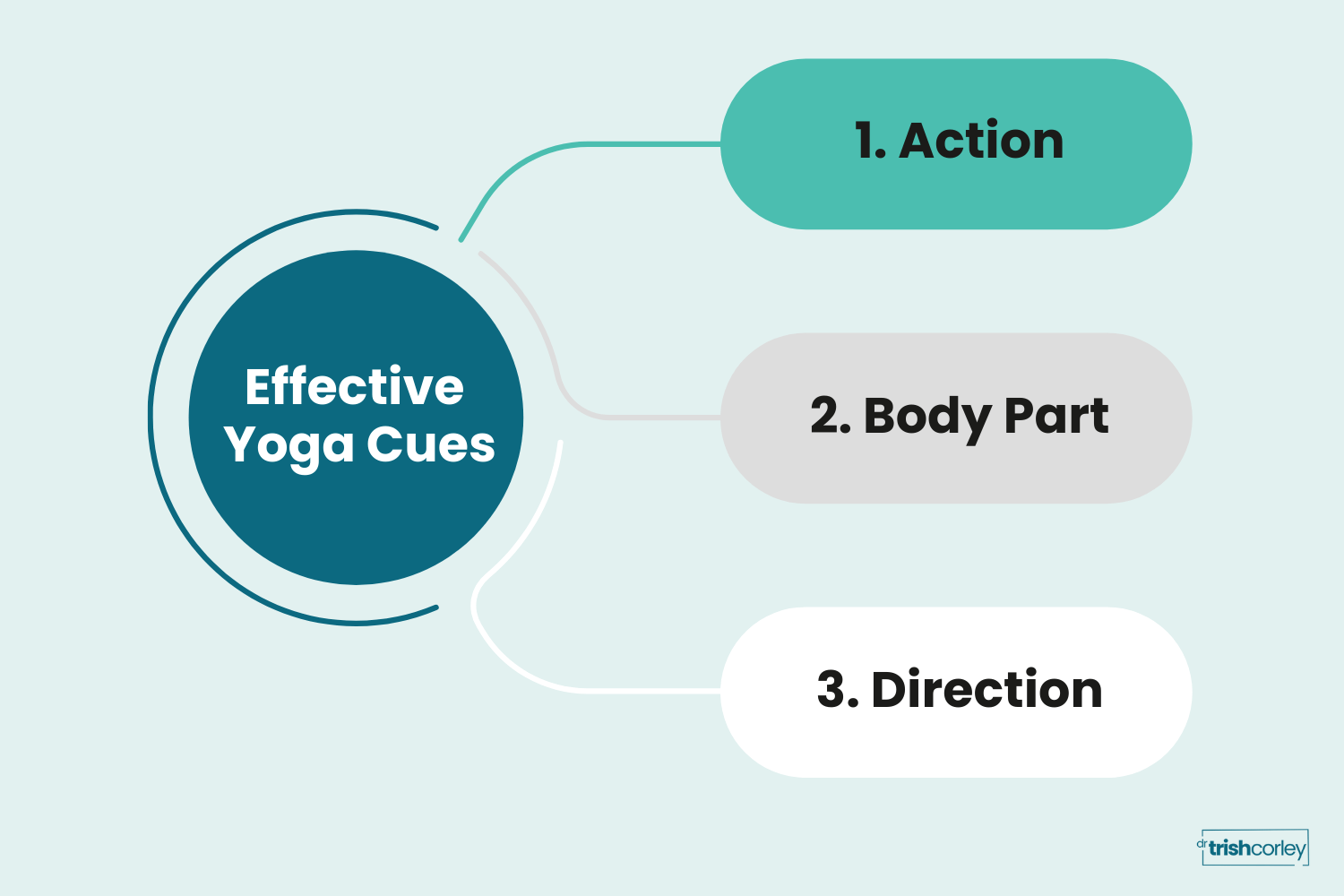
1. Action (The Verb)
Start with an imperative verb. This is a direct command: step, lift, reach, press, squeeze, draw.
Many yoga teachers default to present participles (the "-ing" form): stepping, lifting, reaching. It feels softer, less bossy. But here's the problem: it's actually harder to follow.
Think about giving instructions to a three-year-old who needs to clean up their toys.
Would you say: "Put the toy in the box."
Or: "Putting the toy in the box."
The first one works. The second one sounds like you're narrating something that's already happening. There's no clear instruction to follow.
Clarity is kindness. Your students came to class to be guided. Give them clear commands.
2. Body Part
Be specific about which body part should move. Use language your students actually understand.
Good examples: your right foot, your left hand, your shoulder blades, the back of your pelvis
Avoid anatomy jargon most people don't know: your gastrocnemius, your serratus anterior, your calcaneus
Most students don't know where their serratus anterior is. They do know where their shoulder blades are.
You can get more specific as you develop your cueing skills. "Your right thumb" is more specific than "your hand." "The outer edge of your left foot" is more specific than "your foot." Start with language that lands.
3. Direction
Tell them where. Give them a landmark.
Good examples: to the front of your mat, towards the ceiling, next to your right hand, towards the wall behind you
Have you ever used GPS directions that say "proceed north"? Unless you're holding a compass, that's not helpful. But "proceed north toward the coffee shop on the corner" gives you an instant reference point.
Your students need the same thing. Use the physical space you're teaching in. The ceiling. The mirror. The front of the mat. The wall with the windows. These landmarks help students orient quickly without having to stop and think.
Examples: Effective vs. Less Effective Cues
Effective 3-part action cues:
"Step your right foot to the front of the mat."
"Reach your left thumb up towards the ceiling."
Less effective versions of the same cues:
"Stepping right foot forward."
"Reaching thumb up."
The second set lacks the direct command. Students have to work harder to understand what you're asking.
Why Specificity Creates Presence
The more specific your cues, the more students connect to their bodies in real time.
When you say "reach your right thumb toward the ceiling," you're creating a tangible link between their physical body and the space around them. That connection fosters presence. Presence creates safety. And safety lets students actually experience the benefits of the practice.
Vague cues let the mind wander. Specific cues bring attention into the body, into the room, into this moment.
The Bottom Line
Clear, effective yoga cues follow a 3-part formula: action (imperative verb) + body part + direction. This structure eliminates confusion, builds student confidence, and makes your teaching more impactful. Give clear commands with specific landmarks. Your students will trust you more, and you'll feel more confident every time you teach.
Want to master this formula with feedback and practice? The Cue with Clarity Training for yoga teachers opens soon. Join the Waitlist to be the first to know when doors open.
Get Curious! Q&A
What makes a yoga cue effective?
An effective yoga cue is clear, specific, and easy to follow in real time. The most effective cues use a 3-part formula: an action verb (command), a body part, and a direction. This structure eliminates ambiguity so students can move confidently without stopping to interpret what you mean.
Why do yoga teachers use "-ing" verbs when cueing?
Many teachers default to present participles ("stepping," "reaching") because it feels softer or less commanding. However, these forms are actually harder to follow because they lack the clarity of a direct instruction. Using imperative verbs ("step," "reach") is clearer and ultimately kinder to your students.
How specific should my yoga cues be?
The more specific, the better. Instead of "your hand," try "your right thumb." Instead of "up," try "up towards the ceiling." Specificity helps students connect to their bodies and the physical space, which creates presence and enhances safety.
Can I be commanding without being harsh?
Absolutely. Clear commands are actually kind because they reduce confusion. You can deliver direct cues with a warm tone. Think about how you'd guide a child through a task: simple, clear, supportive.
Ready to Put This Into Practice?
The 3-part formula is your foundation for clarity in cueing. Want to see it in action and master it for yourself?
The Cue with Clarity Training for Yoga Teachers will give you the complete framework you need to teach any class without doubt. Tust your ability to cue, observe, and adjust.
Learn More and about Cue with Clarity →
Want to start learn some anatomy informed cues you can use right away? My free guide, Cue with Confidence, shows you how anatomy-informed cueing builds trust with your students.
About the Author
Dr. Trish Corley is a Doctor of Physical Therapy (Physiotherapy) and yoga teacher trainer with over two decades of clinical experience. She helps yoga teachers learn anatomy, give clear cues, and create classes their students love. Based in Lisbon, Portugal, she leads the Enlightened Anatomy Course, the Elevate Your Impact Mentorship, and the Power to Lead 200-Hour YTT.