
How to Connect with Yoga Students: 3 Practices That Create Presence
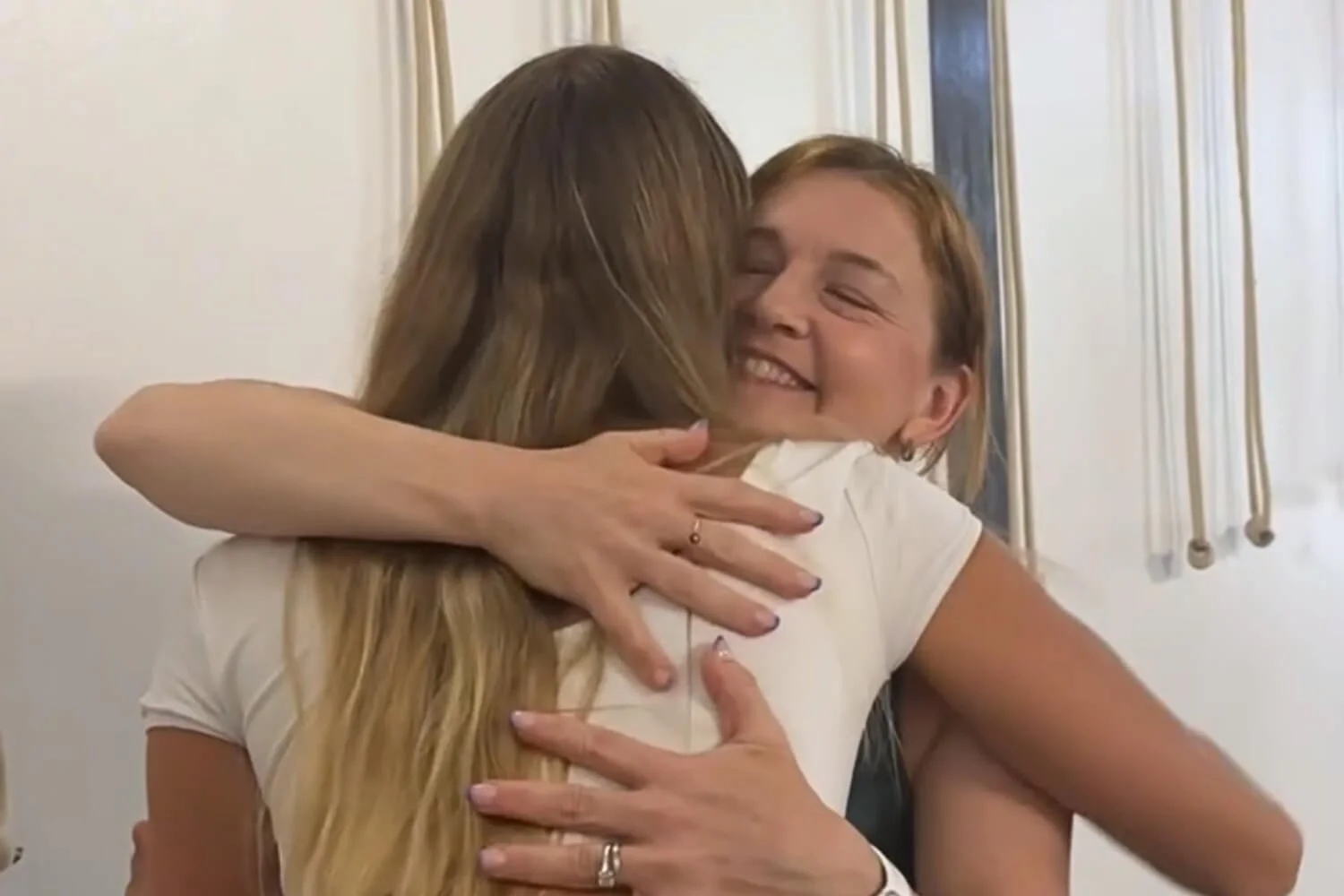
I'd just moved to a new part of Houston and was looking for a studio. Albina said my name and I felt my whole body relax.
I was new to her studio, still figuring out where to put my mat, still glancing around to see if I was doing things right. But when she walked by and said "Hi Trish," something shifted. I wasn't just another body in the room. I was there.
She did it every class. Made eye contact. Spoke directly to me during practice. Not in a way that put me on the spot, but in a way that made me feel seen.
I kept coming back. Then I started coming more. Then I became part of the community, eventually welcoming new students with the same energy Albina had shown me. That studio became one of the best yoga communities I've ever experienced.
When I opened my own studio years later, students would tell me how welcomed they felt walking through the door. And I knew exactly where that came from.
The neuroscience behind human connection helped me understand WHY it mattered so much
Connection isn't just a nice bonus in yoga. When students feel seen, their nervous systems register safety, allowing them to actually be present in their bodies. You can create this through intentional practices. Here are three that work: use names, positioning yourself to maintain eye contact, and observe people closely enough to personalize your cues.
In This Article:
Why connection matters at the nervous system level
How to greet students in a way that signals safety
Where to position yourself to see and be seen
How to observe and tailor cues for individual students
Why Connection Matters (At the Nervous System Level)
Yogis have understood the power of connection for thousands of years. Modern science may still be catching up.
Here's what we know for certain: your autonomic nervous system regulates your body's response to stress and safety. Research consistently shows that social support reduces cortisol, the body's primary stress hormone (Heinrichs et al., 2003; Ozbay et al., 2007). When you feel threatened or uncertain, your sympathetic nervous system activates. Heart rate increases. Breathing shallows. Muscles tense. Your body prepares to protect itself.
When you feel safe, the parasympathetic nervous system takes over. Heart rate slows. Breathing deepens. Your body can rest, digest, and actually be present.
What shifts you from one state to the other? Many things. But one of the most powerful is human connection. Eye contact. Hearing your name. Feeling seen by another person.
Polyvagal Theory, developed by Stephen Porges, attempts to explain this further. Porges proposes that social cues directly influence our nervous system's sense of safety. It's a theory, not settled science, and it has its critics. But it points to something yogis have known through experience long before we had the language. Connection calms us. Presence heals.
You don't need to fully understand the neuroscience to feel it in your own body. Think about walking into a room where someone genuinely welcomes you versus a room where you're ignored. Your body knows the difference before your mind catches up.
The three practices below work with this reality. They help your students' nervous systems regulate so they can actually receive what you're teaching.
1. Greet Students by Name
The simplest way to signal safety? Say someone's name.
When you greet a student by name as they walk in, you're telling their nervous system: I see you. You belong here. That recognition shifts them out of the low-level vigilance most people carry into new spaces.
You don't need to know everyone's name on day one. If someone's new, introduce yourself and ask theirs. If you forget, just ask again. "Remind me of your name?" isn't awkward. It's connection.
Use their name during class too. Not constantly, but intentionally. When you offer a modification: "Sarah, try this version." When you give a compliment: "Good job, Marcus." These small moments add up.
An empowering approach: Don't wait for students to approach you. Position yourself near the door or somewhere you can connect with students as they arrive. Make greeting people part of your practice, not an afterthought.
2. Position Yourself to See and Be Seen
Where you stand in the room matters more than you think.
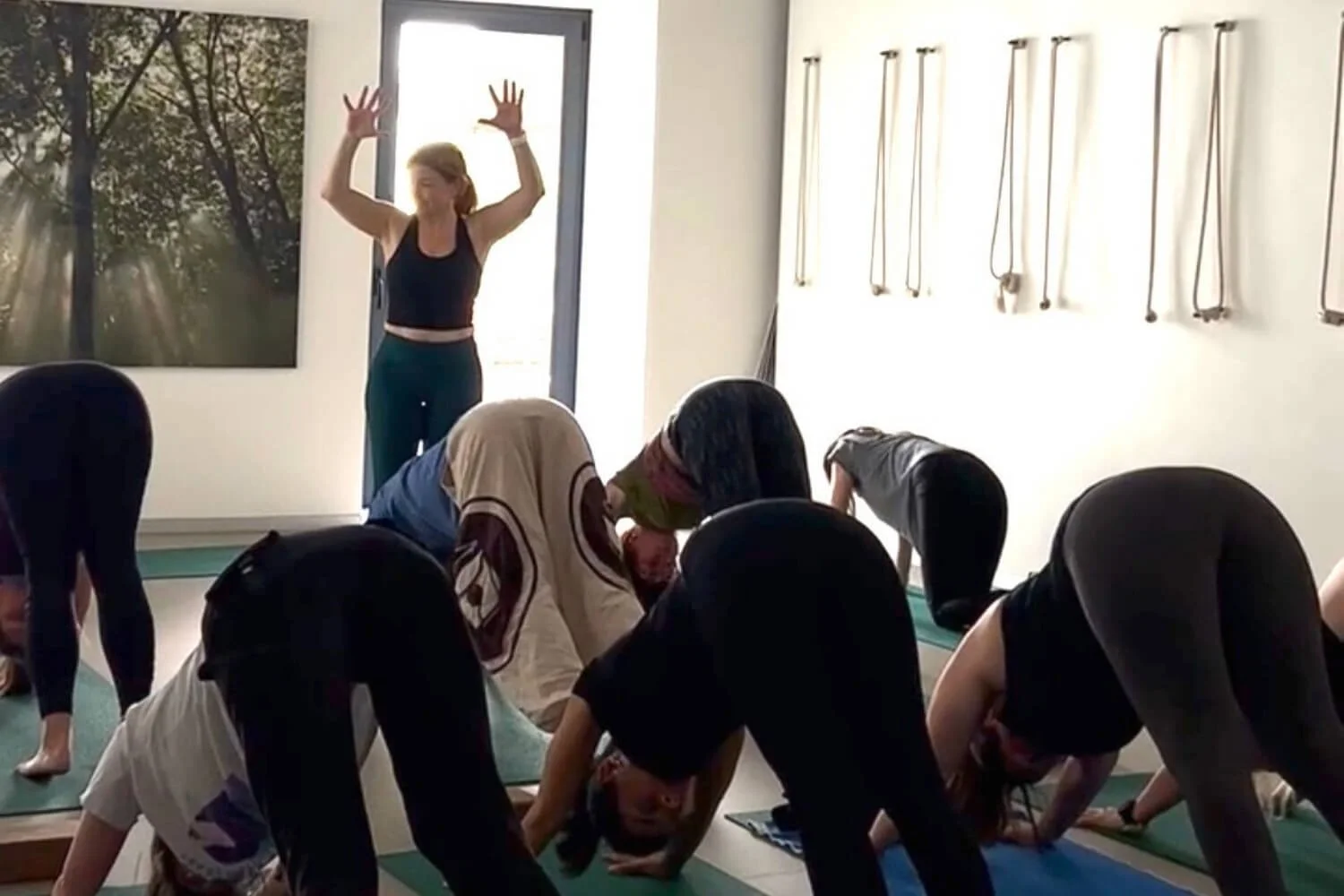
When you're at the front of the room facing your students, you can make eye contact. You can see their faces, read their body language, notice when something's off. And they can see you! This reinforces that sense of connection throughout class.
Your calm, grounded presence becomes a reference point. When you're settled, it helps them settle too.
A few practical shifts:
Stand front and center when giving instructions. Avoid hiding in yoga postures on your mat or lingering at the back of the room.
Distribute your attention across the whole room and ensure you don't accidentally favor one side.
Make deliberate eye contact with individuals as you teach, not just scanning generally.
Move through the room during the practice so you're not always distant to the people in one part of the room.
Here's the thing many yoga teachers miss: if you're on your mat demonstrating every posture, you can't actually see your students. You're looking at your own foot, not at them. Getting off your mat and positioning yourself to observe is one of the most powerful changes you can make.
3. Observe and Tailor Your Cues
Generic cues create distance. Specific cues create connection.
When you watch your students closely and really observe their alignment, their breath, an their facial expressions, you can offer guidance that actually meets them where they are. And when a student hears a cue that lands for their body in that moment, they feel it. They know you're paying attention.
This is the deepest form of presence you can offer as a teacher.
Move around the room during practice. Look at students from different angles. Notice who's holding their breath, who's forcing a posture, who looks confused. Then offer what they need — a verbal cue, a modification, a hands-on assist if appropriate and welcome.
You're not just correcting alignment. You're communicating: I see you. I'm here with you.
A More Empowering Approach: You don't need to cue every student individually every class. Even one or two personalized moments per person can transform their experience. Quality over quantity.
The Bottom Line
Your presence is the most powerful tool you have as a yoga teacher. Not your sequences, not your playlist, not your perfectly crafted cues. The way you make students feel seen and safe is a big part of what brings them back.
This isn't just soft advice. When you greet students by name, position yourself to maintain connection, and observe closely enough to personalize your guidance, you help their nervous system regulate. And that's when real practice becomes possible.
The best yoga class I ever attended wasn't the most creative or physically challenging. It was the one where I felt like I belonged.
Get Curious! Q&A
How do I remember students' names?
Start small. Commit to learning one or two new names per class. Use them during class to help them stick. If you forget, just ask again. Students appreciate the effort more than the perfection.
Where should I stand while teaching yoga?
Position yourself at the front and center of the room where you can see all your students and they can see you. Move through the room during practice, but return to a visible position when giving instructions.
Can I be present with students AND demonstrate postures?
It's difficult to do both well. When you're demonstrating, your attention is on your own body, not on your students. Getting off your mat to observe and cue is one of the most effective ways to increase presence and connection.
What if I feel awkward making eye contact?
Start by softening your gaze. You're not staring, you're seeing. Brief moments of eye contact during a cue or transition feel natural, not intense. It gets easier with practice.
How do I give personalized cues in a group class?
You don't need to cue everyone individually. Observe the room, notice patterns, and offer adjustments that help multiple students. When you do offer individual guidance, use their name and keep it brief.
What does the autonomic nervous system have to do with yoga teaching?
Your autonomic nervous system regulates your stress response. When students feel safe and seen, their parasympathetic nervous system activates, allowing them to relax, breathe deeply, and actually be present in their practice. Your presence as a teacher directly influences this.
Go Deeper with Your Connection to Students
Student connection is one of the six pillars I teach in Elevate Your Impact, my mentorship program for yoga teachers ready to teach with authentic confidence.
Want to start with the foundations? My free guide, Cue with Confidence, shows you how anatomy-informed cueing builds trust with your students.
References
Heinrichs, M., Baumgartner, T., Kirschbaum, C., & Ehlert, U. (2003). Social support and oxytocin interact to suppress cortisol and subjective responses to psychosocial stress. Biological Psychiatry, 54(12), 1389-1398.
Ozbay, F., Johnson, D. C., Dimoulas, E., Morgan, C. A., Charney, D., & Southwick, S. (2007). Social support and resilience to stress: From neurobiology to clinical practice. Psychiatry, 4(5), 35-40.
Porges, S. W. (2007). The polyvagal perspective. Biological Psychology, 74(2), 116-143.
About the Author
Dr. Trish Corley is a Doctor of Physical Therapy (Physiotherapy) and yoga teacher trainer with over two decades of clinical experience. She helps yoga teachers learn anatomy, give clear cues, and create classes their students love. Based in Lisbon, Portugal, she leads the Enlightened Anatomy Course, the Elevate Your Impact Mentorship, and the Power to Lead 200-Hour YTT.