
The Anatomy of Energy in Yoga: A Nervous System Guide
Have you noticed how much yoga teachers like to talk about energy? When I first started practicing (and even when I started teaching) yoga, I had friends say things like, "Hey Trish, you have great energy." Quite frankly, I thought they were being a little woo woo.
Then one day I was teaching a yoga anatomy training focused on the nervous system. As I explained how the nerves relay messages throughout the body, I realized I was actually talking about energy, in a concrete, scientific way.
Energy in yoga isn't just a feeling. It's the electrical and chemical signaling your nervous system uses to move your body and process everything your body senses.

In This Article:
Why "energy" in yoga has a real anatomical basis
How your motor pathway moves you into a posture
How your sensory pathway tells your brain what your body feels
The electrical and chemical process that makes it all happen
Energy, From Atoms to the Universe
The concept of energy can be brought all the way down to the level of atomic particles and broadened all the way out to the unknown mysteries of the universe. Opinions on the sources of energy vary, but science has shown that energy is transmitted from nerve to nerve, and that transmission is what allows you to function and express yourself.
Without the transmission of energy from your spinal cord to your muscles and back, your muscles are simply unable to contract and do their job of moving your bones, of bringing you into and out of your postures.
Your Motor Pathway: How You Move Into a Posture
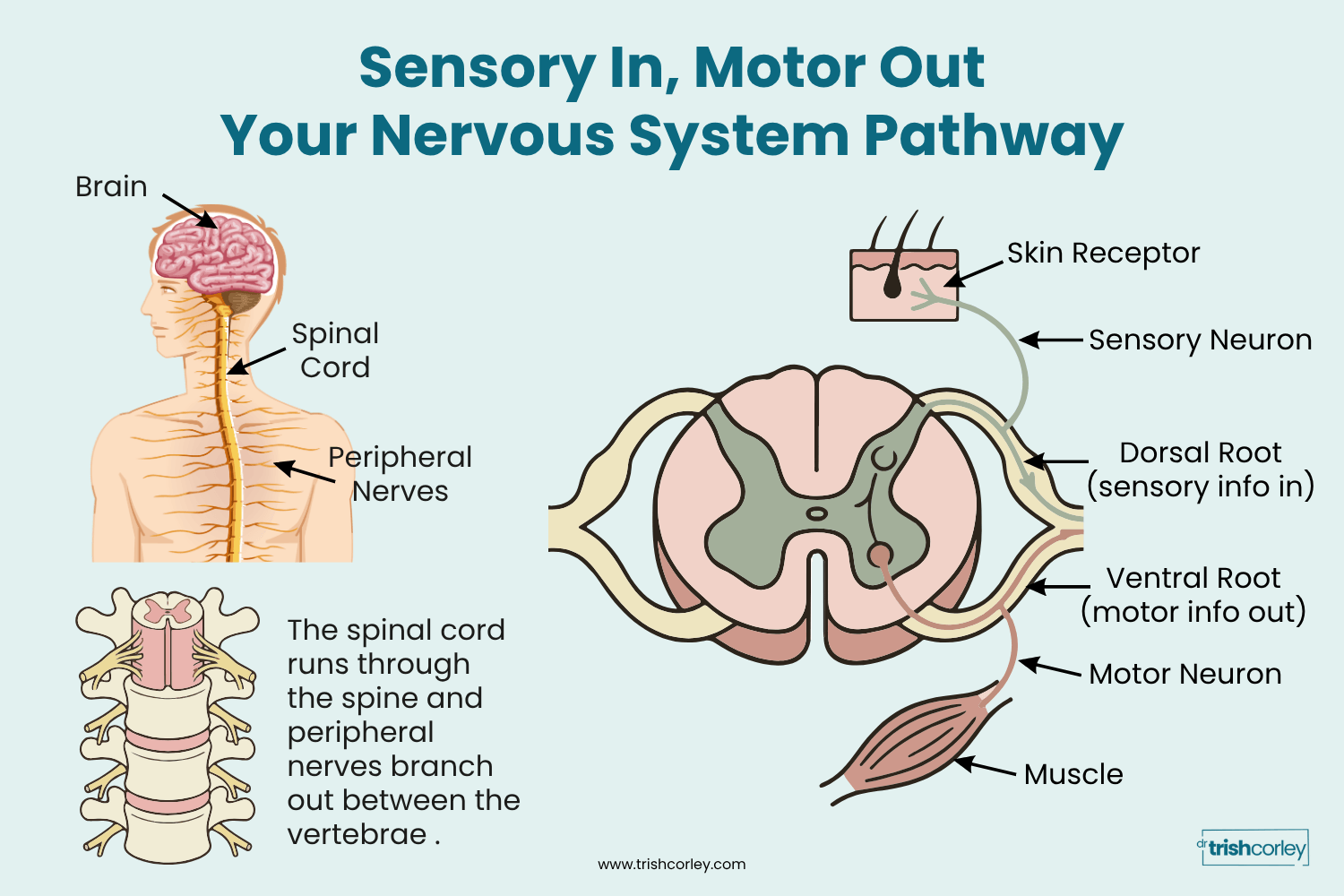
What path does that energy take? Your brain first makes the decision to move your body in a certain way. Say you want to move into Crescent Lunge. Your brain decides it's time for Crescent Lunge, then transmits the message to your muscles to bring one leg forward, one leg back, arms up toward the ceiling.
This message travels as an electrical signal that starts in your brain, moves through your spinal cord, and then through your peripheral nerves (the nerves that extend out through your arms and legs to your fingers and toes). Eventually the message reaches the exact muscle fibers that contract to step your feet apart and raise your arms into Crescent Lunge. In neuroscience, this route from brain to muscle is called the motor pathway.
Your Sensory Pathway: How You Feel a Posture
While the messages needed to move you into Warrior 1 travel down the motor pathway, messages from your body about sensations travel up to your brain via the sensory pathway.
Take the sensation of your foot touching your mat. Your joints and muscles in your foot sense the contact with the ground and the movement of your own body. Those messages travel up your peripheral nerves from skin, joints, and muscles to your spinal cord, then back up to your brain. At the level of your brain, you become aware, consciously or unconsciously, of what your ankle and foot are feeling as they contact the ground in Warrior 1. You then decide how to respond. If something feels uncomfortable, your brain will likely send a message down the motor pathway to shift your ankle into a more comfortable position. If it feels good, your brain sends the message to stay right where you are.
There are moments where that decision isn't automatic. Do you move, or do you stay still? The practice of asana is, in large part, the practice of increasing your conscious awareness of exactly that decision. Yoga is about getting conscious to the messages of your nervous system.
The Electrical and Chemical Dance Behind Every Message
Messages are constantly flowing up and down these two pathways. How are they actually delivered? The quick answer is energy.
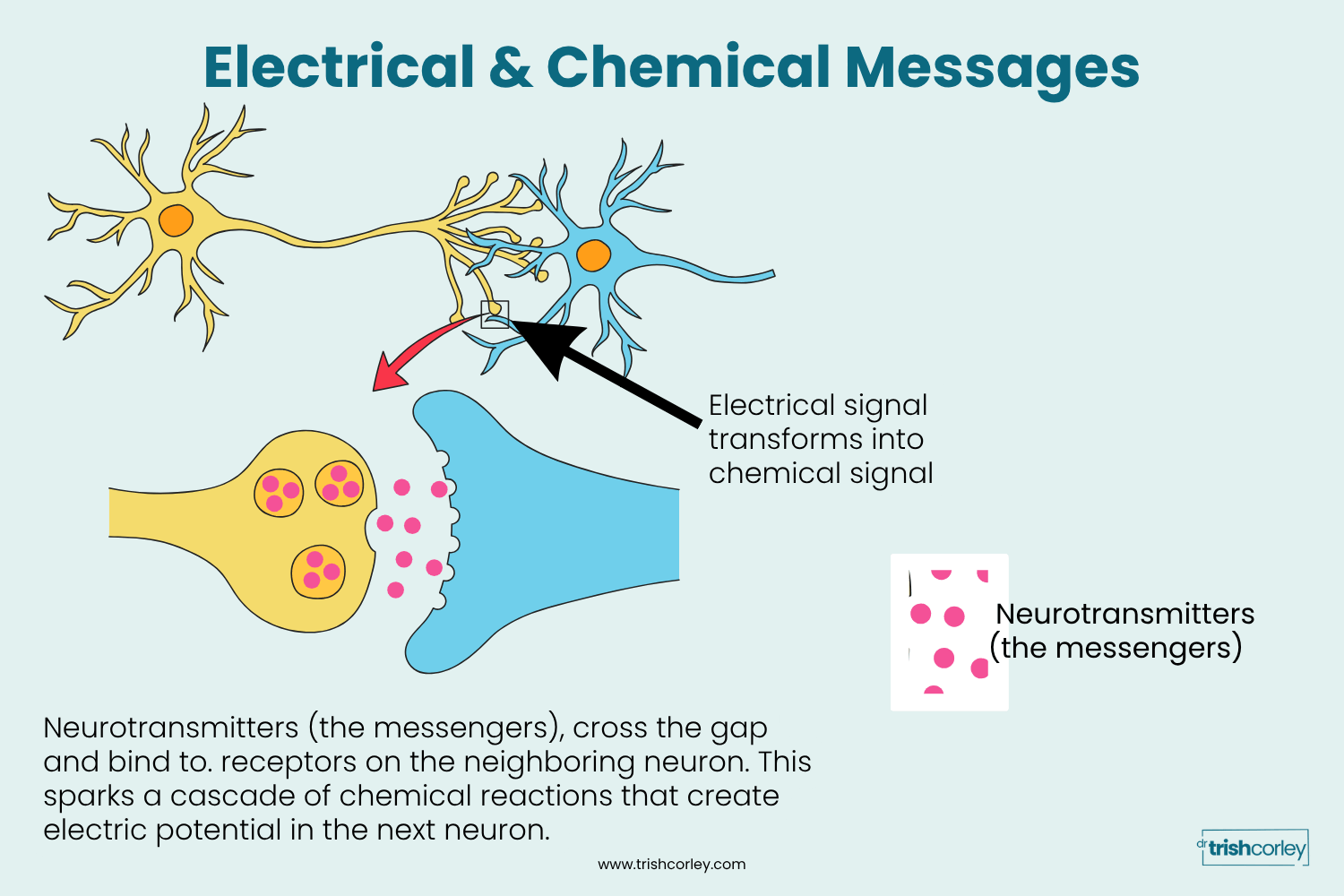
During your practice, the transmission of motor and sensory information relies on a dance between electrical and chemical impulses within your neurons. It starts with a stimulus that sets off a chain reaction. Inside your neurons, there's a delicate balance of charged ions, like sodium and potassium, creating an electrical potential difference across the cell membrane. This resting state holds steady until something triggers a change.
As you move into a challenging posture, your neurons receive signals from your muscles about position and tension. When those signals reach a certain intensity, voltage-gated ion channels in your neuron's membrane swing open, and positively charged ions rush in. This causes a momentary flip in the neuron's charge, an electrical spike known as an action potential, a wave of energy traveling down your neuron's elongated projection, called an axon.
Here's where it turns chemical. Along the axon, insulating layers called myelin sheaths speed up the transmission, like a well greased slide. At the axon terminal, the electrical signal transforms into a chemical one. Tiny sacs release neurotransmitter molecules into the synapse, the tiny gap between one neuron's ending and the next neuron's beginning. These neurotransmitters cross the gap and bind to receptors on the neighboring neuron, sparking a new electrical potential. The signal has passed the baton, and your body interprets the information: move deeper into the posture, or find balance in the midst of movement.
The Bottom Line
When yoga teachers talk about someone's energy, they're tapping into a real anatomical process. The electrical impulses traveling along your neurons carry charged ions, and the neurotransmitters released at your synapses influence your mood, your focus, and your sense of calm.
That's the scientific foundation underneath the idea of energy in yoga. Maybe yogis aren't so weird after all.
Get Curious! Q&A
Is "energy" in yoga a real, measurable thing?
Yes. The transmission of signals along your neurons involves measurable electrical potentials and chemical neurotransmitters. What yoga teachers often describe as energy has a real anatomical basis in your nervous system.
What's the difference between the motor pathway and the sensory pathway?
Your motor pathway carries signals from your brain down to your muscles, telling your body how to move. Your sensory pathway carries signals from your body back up to your brain, telling you what you're sensing and feeling.
Why does understanding this matter for my teaching?
When you understand how signals travel between your students' brains and bodies, you can cue in a way that supports that communication rather than working against it. It gives you language for something you're likely already sensing in the room.
What is an action potential?
An action potential is the electrical spike that travels down a neuron's axon when a stimulus reaches a certain threshold. It's the "wave of energy" that carries a message from one point in your nervous system to the next.
Go Deeper with your understanding of yoga anatomy.
Want lessons like this sent directly to you? Sign up for What Moves You, my weekly newsletter where I break down the anatomy behind your teaching, one insight at a time.
Sign up for “What Moves You” →
About the Author
Dr. Trish Corley is a Doctor of Physical Therapy (Physiotherapist) and yoga teacher trainer with over two decades of clinical experience. She helps yoga teachers learn anatomy, give clear cues, and create classes their students love. Based in Lisbon, Portugal, she leads the Enlightened Anatomy Course, the Elevate Your Impact Mentorship, and the Power to Lead 200-Hour YTT.