
"Square your hips."
It might be the most common cue in Warrior 1, and it's also one of the most misunderstood. I hear yoga teachers say it often and it is almost always taught like it's a fixed target everyone should be able to hit.
Here's the thing though. Squaring your hips in Warrior 1 isn't about effort. It comes down to how much hip extension and external rotation you actually have in your back leg.
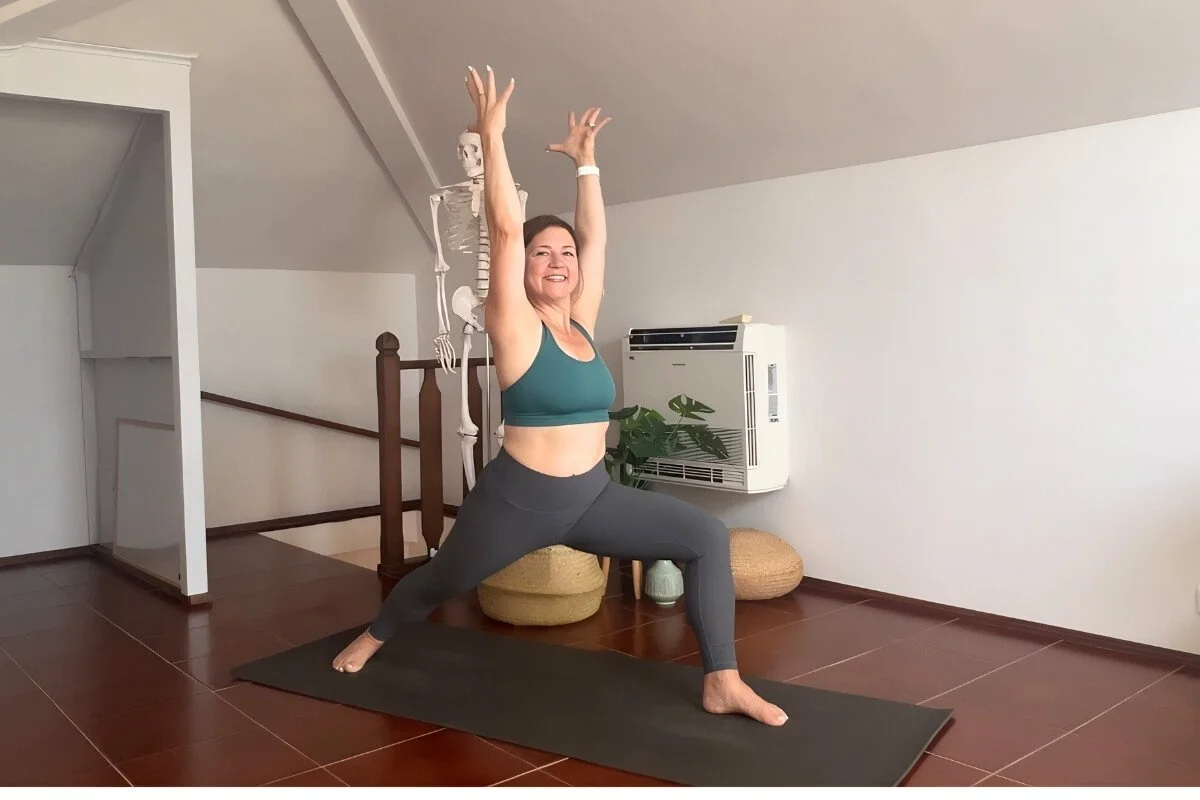
Warrior 1 alignment depends on how much hip extension and external rotation you have in your back leg, not on how hard you try to square your hips.
In This Article:
What "squaring the hips" actually means in Warrior 1
Why your back leg's range of motion sets the limit, not effort
A more empowering cue to use instead of "square your hips"
How your foundation and front knee still support the whole posture
What Squaring the Hips Means in Warrior 1
When teachers cue "square your hips," they're usually asking for a neutral pelvis, meaning both hip points (your ASIS, the two bony points at the front of your pelvis) face directly forward. I've written before about how to find that landmark on your own body in How to Find Neutral Pelvis in Yoga, so I won't repeat the full anatomy lesson here. What matters for Warrior 1 is what happens when you bring that neutral position into a posture where one leg is extended behind you.
What Determines How Much Your Hips Square in Warrior 1
Your back leg has a job here that often gets overlooked. To keep your hip points facing forward while your back foot stays grounded, your back leg needs a certain amount of available hip extension and hip external rotation. Without enough range of motion in these directions, you just won’t be able to bring your hip points to face forward. Something will need to give. that position pulls your pelvis along with it instead of letting it stay still.
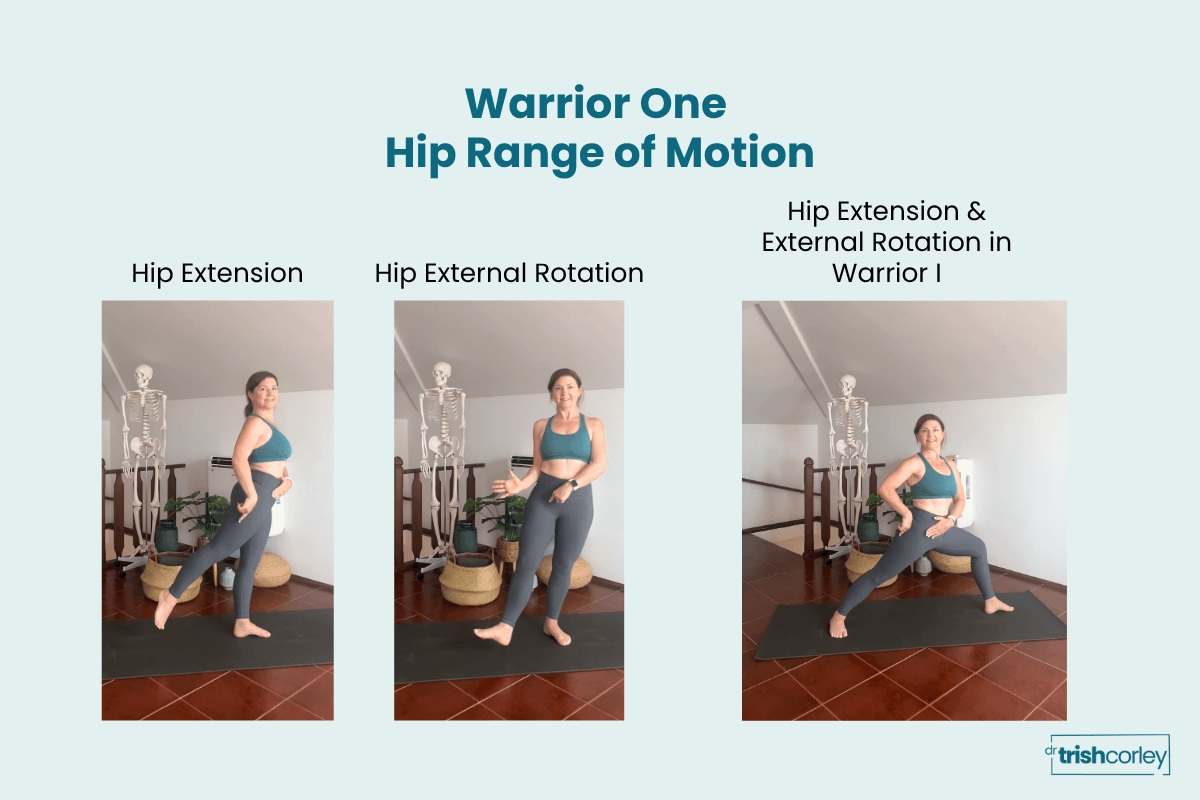
Many bodies don't have the range of hip extension and/or hip external rotation available. A 2018 study published in Physical Therapy in Sport looked at how pelvic rotation shows up during hip extension measurements. The researchers found that when true hip extension is limited, the pelvis rotates to make up the difference, especially in women. In other words, your body finds the range somewhere. If it's not coming from your hip joint, it borrows it from your pelvis instead.
This is why many people feel challenged to bring both hip points to face forward. It is also why we should not force it - in our own practice or a teachers guiding students in Warrior 1. It is okay for the hip points to be facing off to the side of the mat. For example, in Warrior 1 with the right foot forward, it’s okay if the hips points are angle towards the left side of the mat.
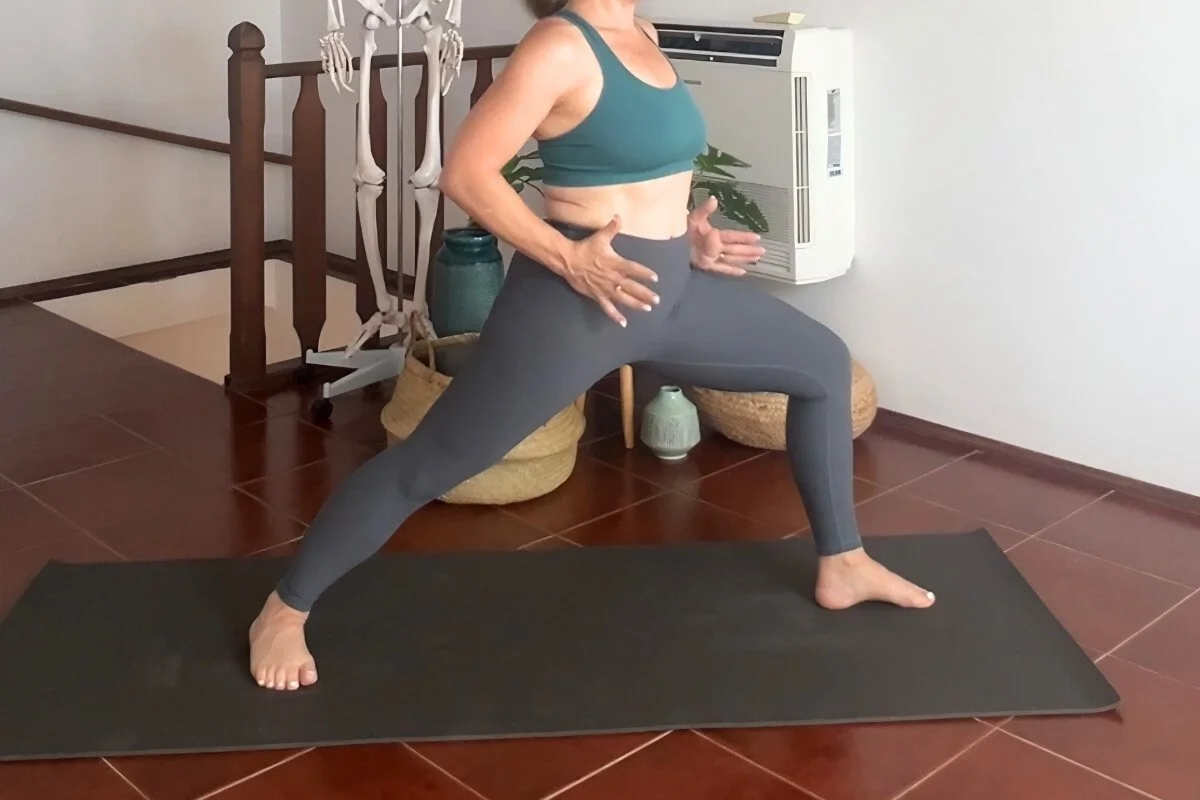
If the range of motion is not available at the hip and a student tries to force "square hips" in Warrior 1 anyway, something will have to compromise. It’s best to allow the alignment of the pelvis (as I described above) to be what compromises. If we don’t let the pelvis compensate as in naturally wants to, the knee or low back (the joints near the hip/pelvis) will likely be compromised. And that can result in pain and potential injury to the knee or low back.
A More Empowering Approach
Instead of demanding a fully squared pelvis, try inviting whatever rotation is genuinely available. With a student in Warrior 1 with their right leg forward, you might say, "Aim to bring your left hip point toward the front of your mat without forcing,"or "Press the front of your left hip forward while keeping your back foot grounded, and avoid forcing." Either keeps the direction of effort the same without asking for a range that may not exist yet.
Squaring further isn't a sign of more advanced practice. It's a sign of more available hip extension and external rotation, which can change over time with consistent practice. It is not something to force.
The Position of the Feet Matters
While I’ve been discussing the position of the pelvis so far, it is also important to explore the position of the feet in Warrior 1. The feet are the foundation. And the placement of the feet has a direct impact on the position of the hips. If the feet are in one line with each other, this positions the hips into some adduction, which ultimately limits the hips ability to externally rotate.
I suggest to keep the feet as if they are on two lines (aka two railroad tracks) so that there is no adduction, and ultimately a bit more access to external rotation, especially for the back leg.
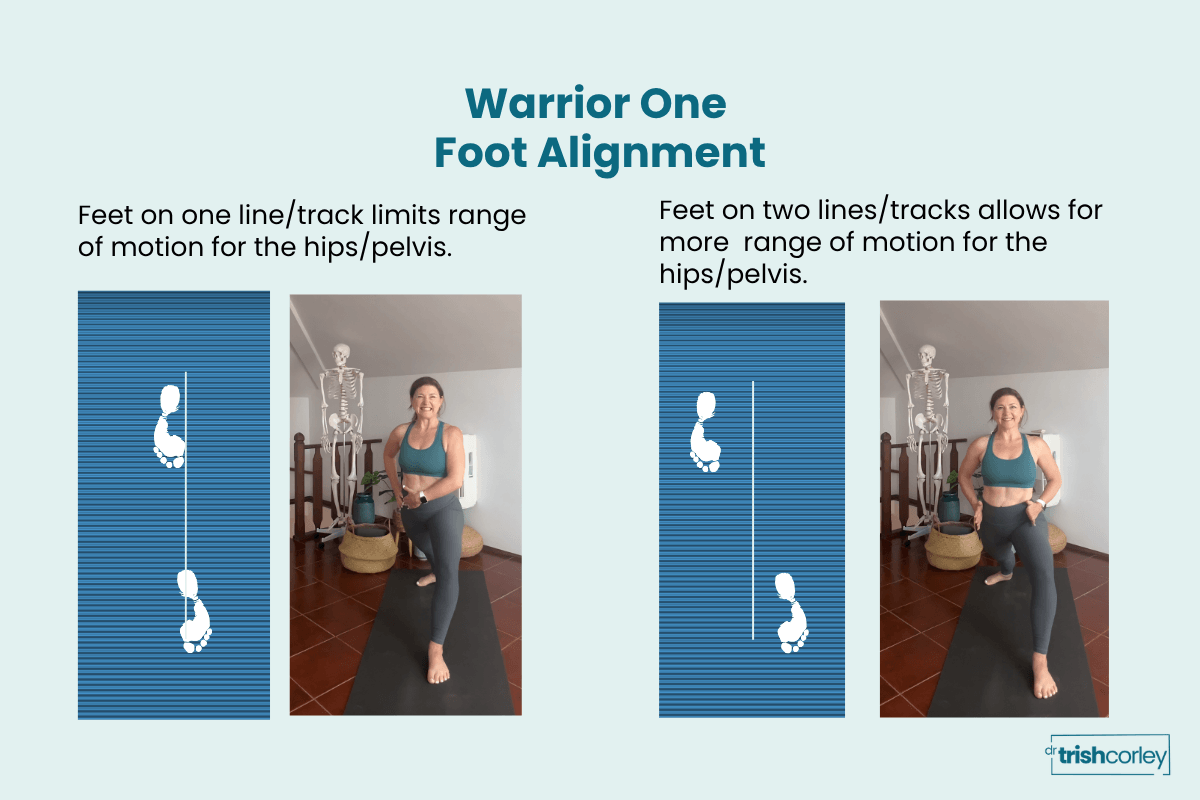
For more on why a wider stand gives the pelvis more room to move, check out my other article titled Yoga Modifications: Adapt Any Posture with One Principle.
The Bottom Line
Warrior 1 alignment isn't about forcing your hips into a perfectly square position. It's about understanding how much hip extension and external rotation your back leg has available, and working with that range instead of against it.
Get Curious! Q&A
Why can't I square my hips in Warrior 1?
Squaring your hips in Warrior 1 requires hip extension and external rotation in your back leg. If that range is limited, your pelvis may rotate to compensate instead, which means full squaring isn't available yet, not that anything is wrong.
Is it a problem if my hips don't fully face forward in Warrior 1?
No! A partially rotated pelvis in Warrior 1 often reflects your current hip range rather than a mistake. Forcing further rotation than your hip joint allows is more likely to create strain than improve the posture.
Should I stop cueing "square your hips" altogether?
Not necessarily. The direction is still useful. What can shift is the framing, inviting students toward more rotation rather than presenting a fully squared pelvis as the required endpoint. Observe the students in front of you and guide them based on what you see!
What are good ways to modify Warrior 1?
As discussed above, there are several ways to modify Warrior 1. You can allow the pelvis to stay facing the side of the mat a bit and/or separate the feet wider away from each other. Another option is to practice Crescent lunge instead. With this posture, the hip of the back leg is in extension without any rotation. No hip external rotation is required!
Go Deeper with your understanding of anatomy and cueing
Hip alignment is one piece of a much bigger picture. The Cue with Confidence guide walks you through three anatomy informed cues, the reasoning behind each one, and a preview of the Balanced Posture Alignment framework I teach inside the Enlightened Anatomy Course.
Download the Free Cue with Confidence Guide →
References
Beneck, G.J., Selkowitz, D.M., Skeie Janzen, D., et al. The influence of pelvic rotation on clinical measurements of hip flexion and extension range of motion across sex and age. Physical Therapy in Sport, 30 (2018), 1 to 7.
About the Author
Dr. Trish Corley is a Doctor of Physical Therapy (Physiotherapy) and yoga teacher trainer with over two decades of clinical experience. She helps yoga teachers learn anatomy, give clear cues, and create classes their students love. Based in Lisbon, Portugal, she leads the Enlightened Anatomy Course, the Elevate Your Impact Mentorship, and the Power to Lead 200-Hour YTT.