
Yoga Knee Pain: Why Your Hips Are Usually the Cause
Yoga Knee Pain: Why Your Hips Are Usually the Cause
Yoga and knee pain should not go together. You likely practice and/or teach yoga to be healthy, not to create injury.
Many people that practice yoga have underlying knee injuries and many others simply begin to practice yoga and knee pain arises. With a basic understanding of the anatomy of the hip and knee you can help prevent injury and avoid knee pain in yoga.
I've known at least two people who hurt their knees trying to get into Lotus posture. Both were experienced practitioners who pushed past what their hips were ready for, and that is preventable!
Knee pain in yoga is most often a hip problem, not a knee problem. When there isn't enough hip mobility available, the knee absorbs forces it was never designed to manage….and this was the reason the people I mentioned above hurt themselves trying to get into lotus.
In This Article:
Why the knee is vulnerable in yoga
Basic anatomy of the hip and knee
What happens in Pigeon when hip mobility is limited
Modifications for Pigeon posture
What happens in Lotus when hip mobility is limited
How to tell if tension is coming from muscle or ligament
Basic Anatomy of the Knee
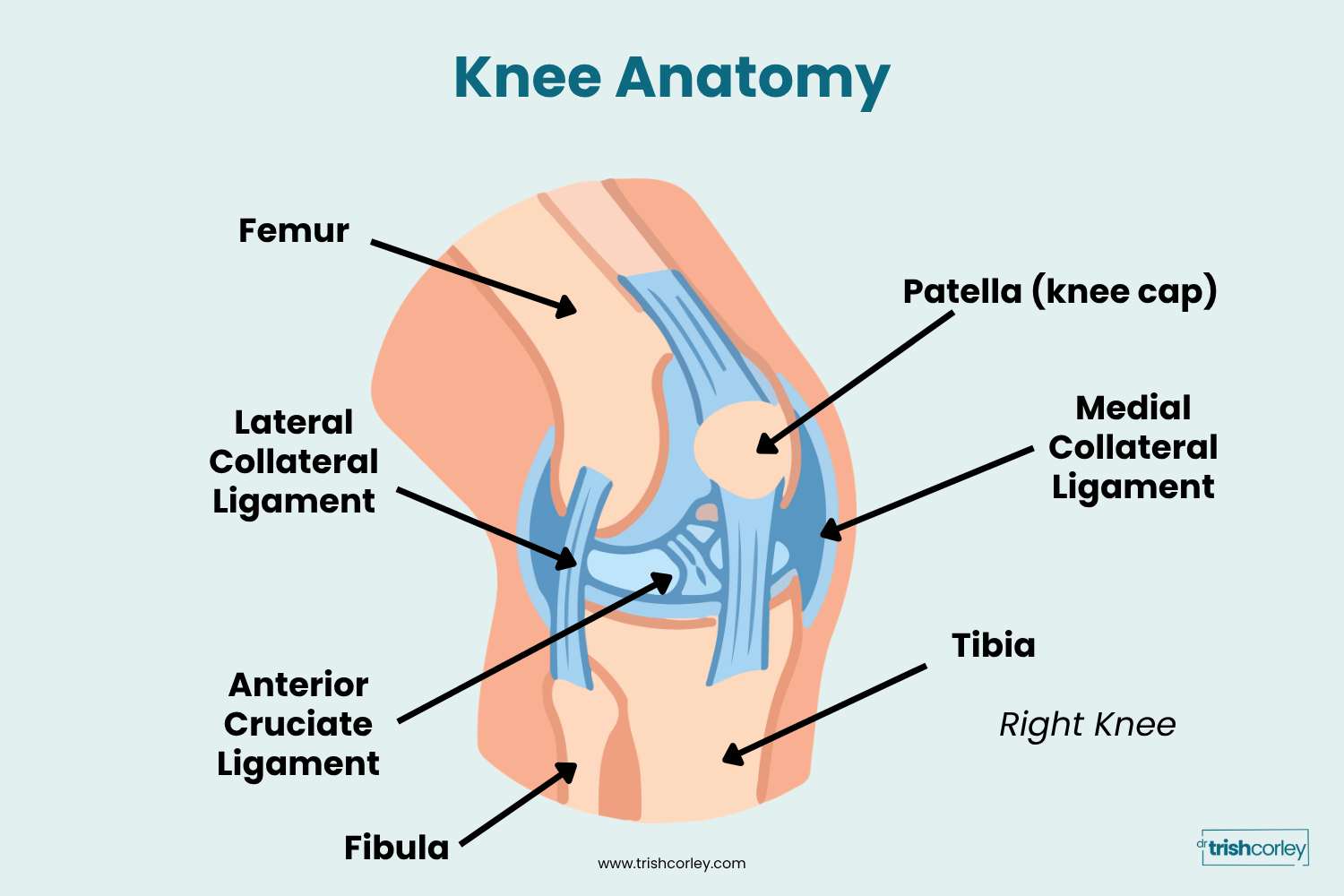
Your knee joint is made primarily of four bones: the femur (long thigh bone), tibia (shin bone), fibula (the smaller bone alongside the tibia) and the patella (knee cap). Your femur and tibia move forwards and backwards on each other causing the knee to bend and straighten. These motions are respectively referred to as flexion (bending) and extension (straightening) of the knee.
A common misunderstanding of the knee is that it is only made to bend and straighten. Flexion and extension are the larger and more obvious movements, but the knee is not a true hinge joint as it is often mistaken to be. The knee also rotates.
Many yoga postures require your knees to rotate. Given that rotation is a natural movement of the knee, it is safe to allow the knees to rotate. However, it is unsafe to rotate the knee beyond its available limits. As a rule of thumb, if you or your students experience knee pain in yoga postures that was not already present, that's a signal to change the way the posture is being practiced.
Most yoga knee injuries result from over-rotating the knee when hip mobility is limited. Before we look at how that plays out in specific postures, let's look at the anatomy of the hip.
Basic Anatomy of the Hip
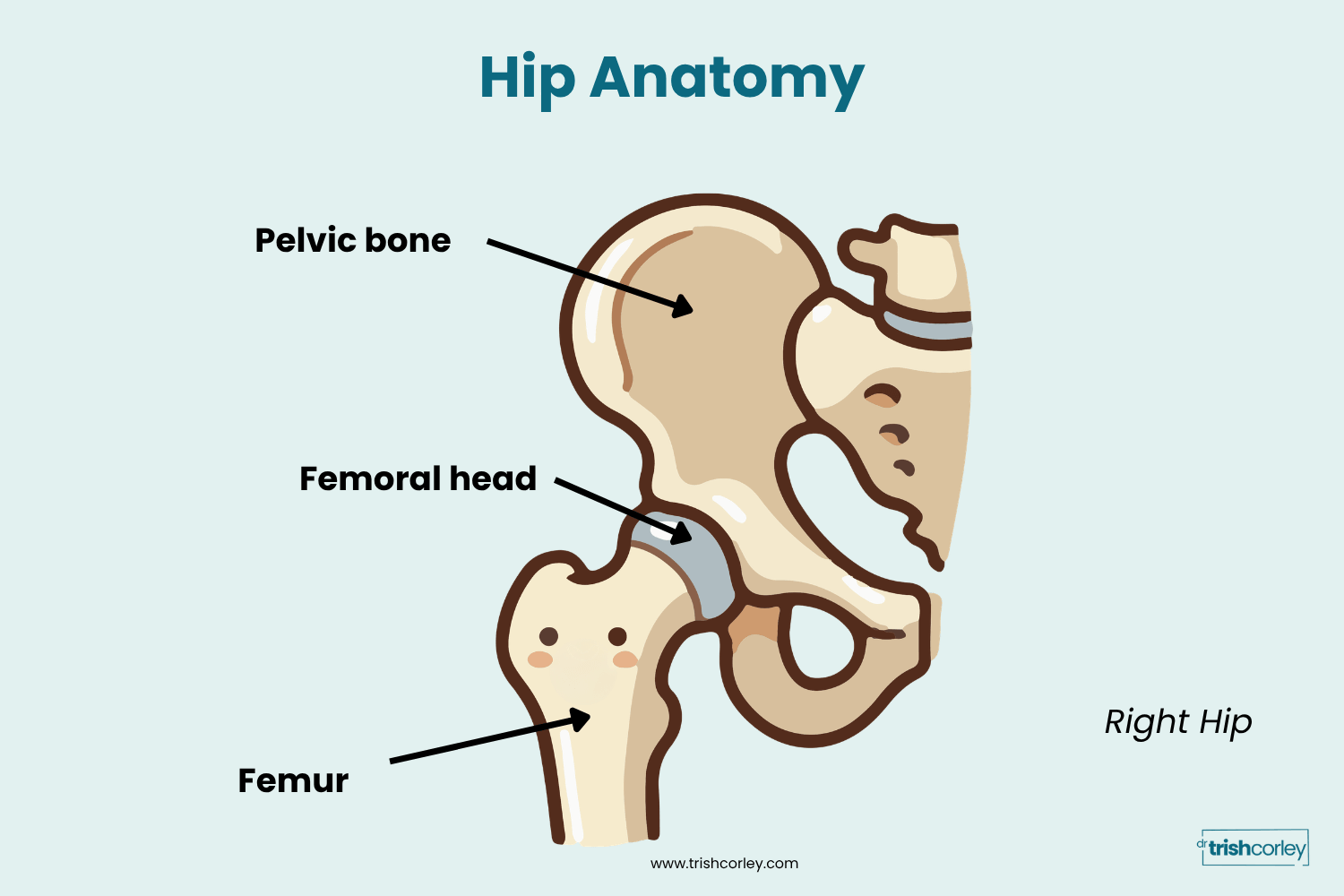
Your hip joint consists of two bones: the femur (long thigh bone) and the pelvic bone. The top part of the femur is shaped like a golf ball. This is referred to as the head of the femur (or femoral head). The pelvic bone has a large concave area called the acetabulum. This creates the socket for the femoral head.
The hip joint is a ball and socket joint. The femoral head rolls around inside the acetabulum allowing for a variety of motions at the hip including flexion and extension, abduction and adduction, and internal and external rotation.
Of all these motions, external rotation is the one that matters most when it comes to knee pain in yoga. Two of the most commonly practiced postures — Pigeon and Lotus — both require significant hip external rotation. When that rotation isn't available, the compensation often occurs at the knee.
Knee Pain in Pigeon Pose and Hip Mobility
Pigeon posture is often described as a "hip opener" and it absolutely can be. It is a good posture for increasing external rotation of the hip.
In Pigeon, the front leg is positioned in hip flexion and hip external rotation. When adequate external rotation is available at the hip, the femur rotates freely in the acetabulum and the knee remains in a relatively neutral position. When that hip external rotation is not available, the femur cannot rotate fully in the socket and the rotation has to come from somewhere. That somewhere is often the knee joint. You now know that the knee does rotate, but remember - only a small amount. If excess knee rotation occurs, the ligaments of the knee can be compromised and potentially injured.
If you notice an increased amount of pressure on either side of your knee or deep inside your knee in Pigeon, it is best to modify the posture so that your ligaments are not put under too much stress.
Modify Pigeon to Keep the Knees Safe
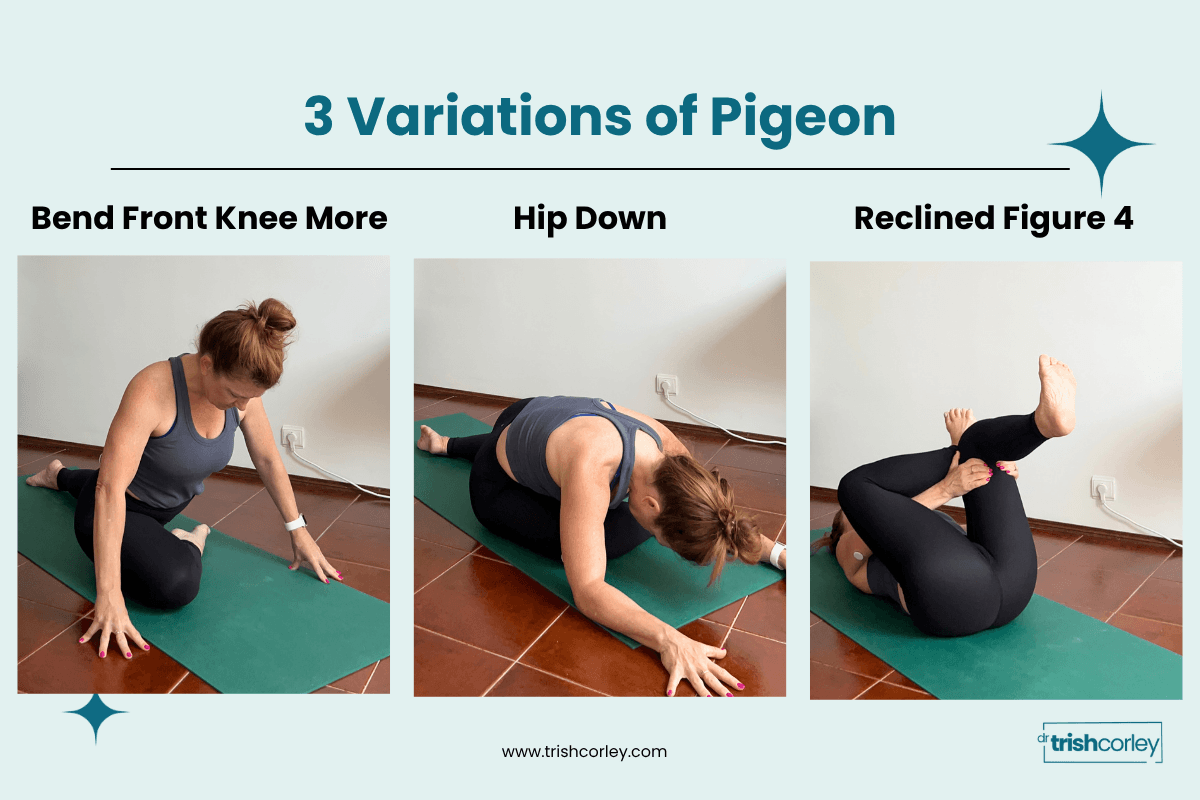
1. Bend your front knee more.
Yoga teachers sometimes imply that the front shin should be parallel to the front of the yoga mat in Pigeon. That is a possibility and the direction to move towards to increase hip external rotation. It is not, however, necessary. It is more than okay to bend your front knee more and bring your heel closer to your groin. This will decrease the tension in your front knee and reduce the risk of injury to the ligaments.
2. Rest your hip down on the mat.
Bring the hip of your front leg down to the ground. As your hips gain range of motion, you can gradually begin to center the hips. For example, when your left leg is in front, rest the outside of your left hip and thigh on the floor and gradually send your right hip back down towards the floor. With time your left hip may have increased external rotation and you may be able to bring your left hip back up so that both hips are centered.
3. Try reclined figure four.
Lie on your back and bend both knees with your feet on the ground. Cross one leg over your other thigh to create a triangle with your leg. Reach one hand through the triangle and your other hand on the outside of the uncrossed leg. Pull the thigh of the uncrossed leg towards you and you will stretch the outside of that hip. This gives you a similar position in the hips as Pigeon posture without the same level of stress on your knees.
Lotus Posture and Hip Mobility
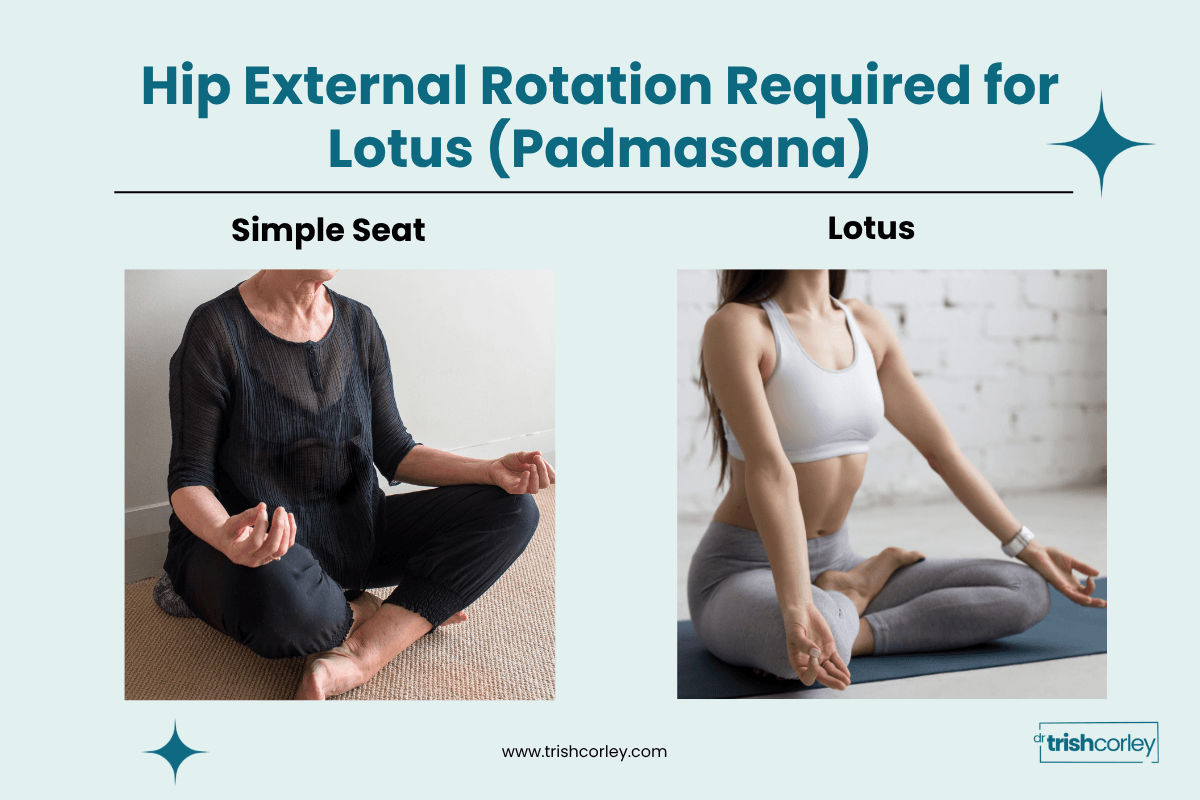
In order to bring your feet up onto your thighs in Lotus posture (Padmasana), it is essential to have a significant amount of external rotation in your hips. That is, your hips must be able to rotate open so that your outer thighs and knees come close to the floor.
Just like in Pigeon, when adequate external rotation is available at the hip, the femur rotates freely in the acetabulum. If your outer thighs and knees are supported on the floor or at least very close to the floor, your knees are in a position to attempt to bring your feet on top of the thighs without forcing excess rotation in the knee.
When that hip external rotation is not available, the knees will be elevated from the ground. If this is what is happening for you (or your students) it’s a good indication that there is not adequate hip external rotation available to attempt lotus. This is what we saw with pigeon. Given that Lotus requires significantly more hip external rotation than Pigeon, the risk to the knee is even greater with Lotus
So if your knees are elevated off of the ground in a simple cross legged position, it is best to stay in a cross legged position rather than forcing Lotus posture.
How to Tell If Your Knee Tension Is Muscle or Ligament
How do you know if you are forcing too much rotation at your knee?
When your knee is flexed, the only muscles being stretched (lengthened) should be the quadriceps. If you feel a stretching sensation or some tension just above the center of your knee, you are likely stretching your quadriceps which is perfectly safe and healthy.
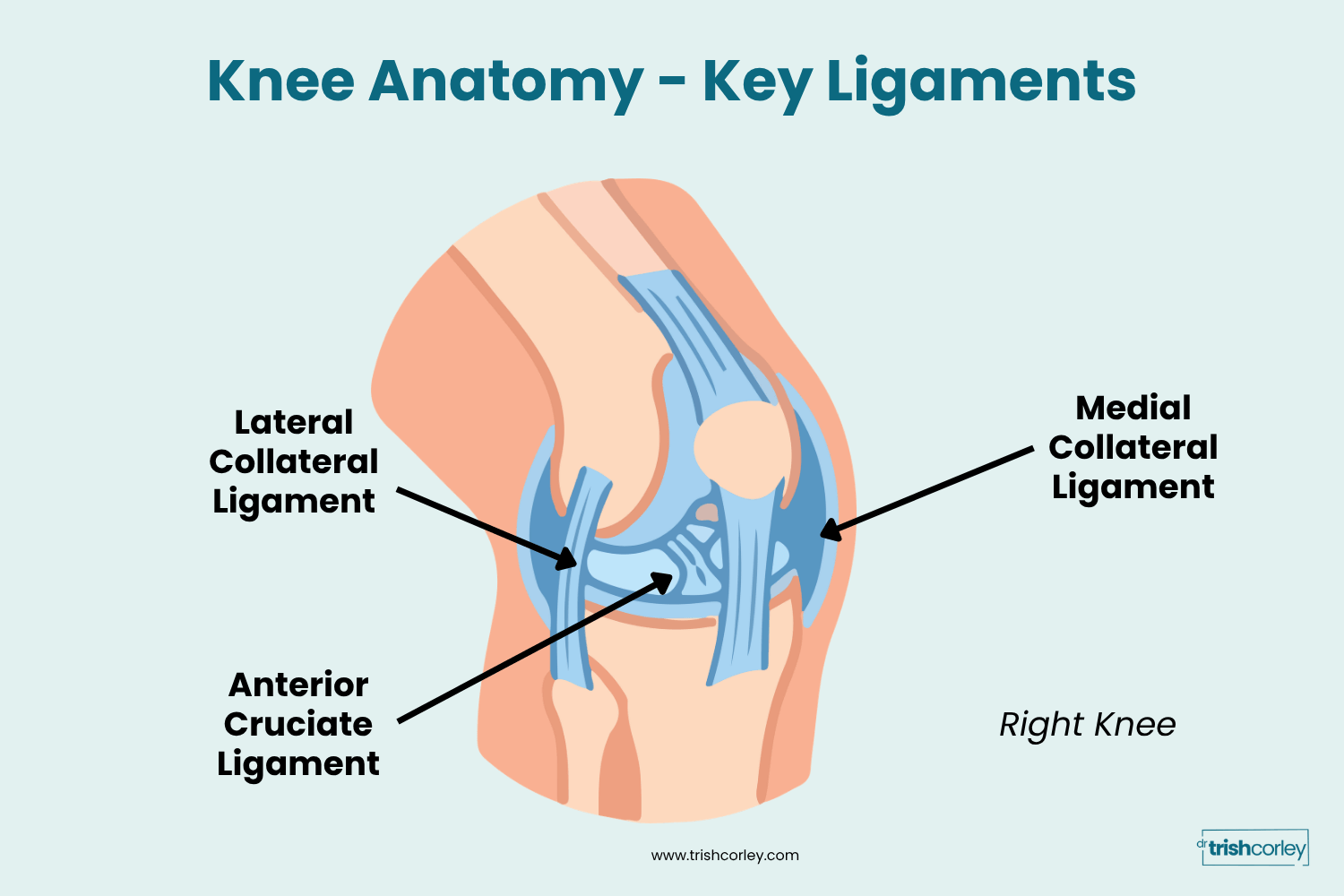
If you notice an increased amount of pressure on either side of your knee or deep in the center of your knee, you are likely stressing your ligaments. The role of ligaments is to hold bones together and to limit excessive movement. There are several ligaments in your knee that hold the femur and tibia together. In an attempt to come into Lotus posture, it is relatively common to notice increased pressure on the outside of the knee where the lateral collateral ligament is located.
If you feel that increased pressure on the outside of your knee and keep pushing yourself into Lotus, you may cause damage to your lateral collateral ligament or other ligaments of your knee. Ligaments are much different from muscles. Stretching them beyond their limits leaves them weak and may lead to long term knee problems. Hence we need to be willing to adapt the posture to what is needed. In this case, a cross legged seat is probably a better option.
Flex Your Feet to Create Stability in the Lower Leg
While teaching Pigeon, many yoga teachers instruct students to flex the front foot and pull the toes back so that the ankle is in a neutral position. You may have heard the cue "flex your foot to protect your knee." While well-intentioned, that's not quite what's happening anatomically. It is also worth noting the impact you may be having on your students if you use the “to protect” phase. Learn more about that in my article titled "Protect Your Spine: Why This Common Yoga Cue Might Be Creating Fear.”
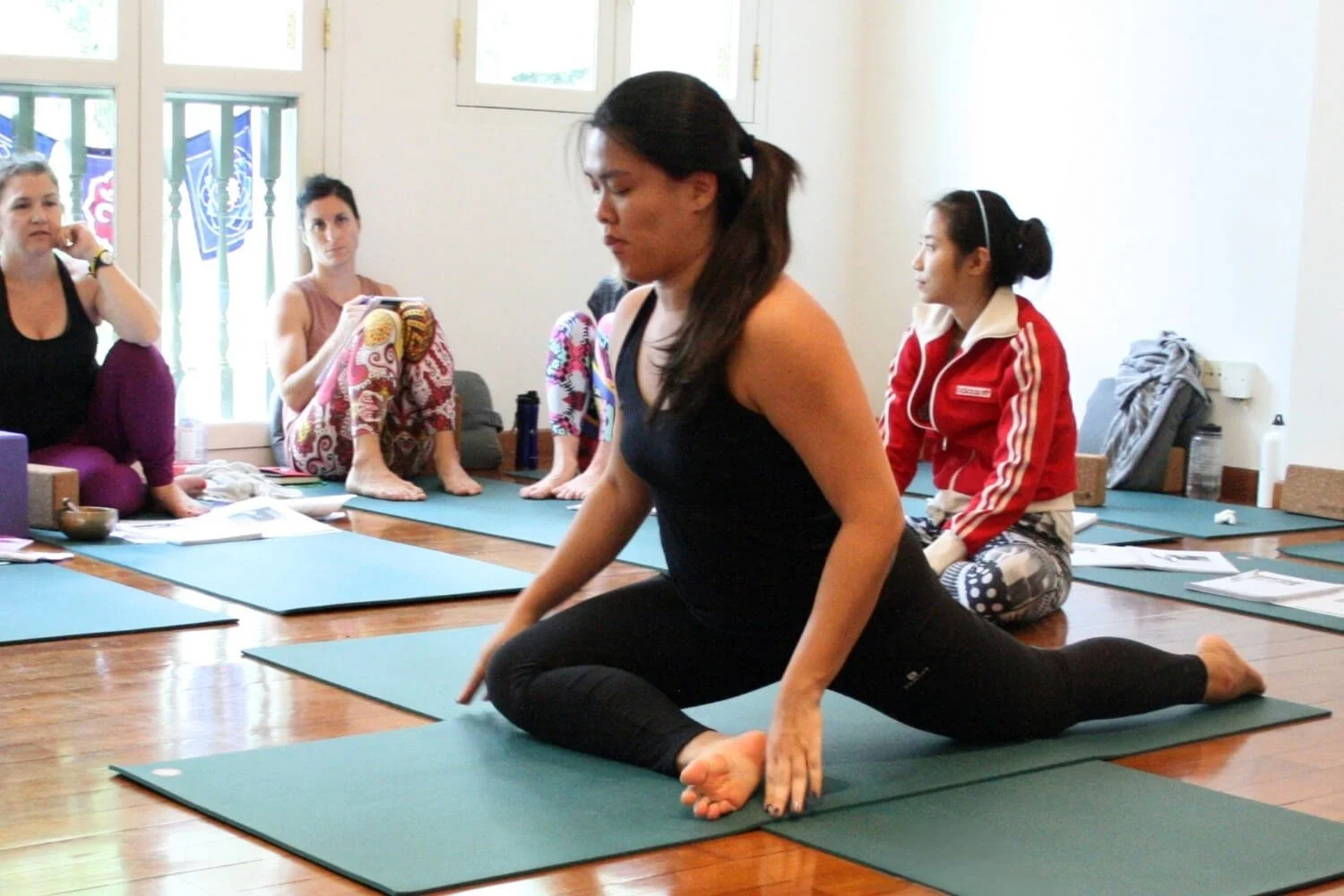
What flexing the foot actually does is activate the foot and ankle muscles required for dorsiflexion (flexing the foot). Several of these muscles are partially located at the knee. Therefore, overall muscle engagement here creates stability throughout the whole lower leg including the knee. As a general rule, stability provides support and limits excess range of motion that leads to injury. So flexing the foot is not a direct protection mechanism for the knee, but rather a wise way to practice asana. As I often say, "we need stability before we can access mobility."
The Bottom Line
Knee pain in yoga is rarely just a knee problem. When the hip doesn't have the external rotation available to support a posture like Pigeon or Lotus, the compensation often occurs at the knee.
When you understand this relationship, you can better observe what is actually happening in your students' bodies. Rather than focusing on the knee, start looking at the hip. Rather than pushing students further into Pigeon, start asking whether their hip is actually ready for where you are sending them.
Being mindful of your students' knees is not only important to prevent injury, but also to maintain healthy alignment for the long run. By keeping the ligaments and joints stable and the knees in a neutral position, stress on the knee joints is limited. As with most things in the body, limiting unnecessary stress allows the joints to live a longer, healthier life.
Get Curious! Q&A
Can yoga cause permanent knee damage?
Yes, it can — and it doesn't have to. Most yoga knee injuries are the result of pushing a posture beyond what the hip is ready for, not the posture itself. Lotus and Pigeon are not inherently dangerous. Practicing them without adequate hip mobility is. The posture is not the problem. The preparation is.
My student has knee pain but no hip tightness — what else could be causing it?
Hip mobility is the most common culprit, but it is not the only one. The ankle joint also influences the knee. If mobility is limited at the ankle, compensation can occur at the knee just as it does when the hip is restricted. It is also worth considering whether the student has a pre-existing knee condition that is being aggravated rather than caused by their yoga practice. When in doubt, refer out.
Should students with existing knee injuries avoid Pigeon altogether?
Not necessarily. It depends on the nature of the injury and how much hip external rotation is available. For many students with knee issues, a well-modified Pigeon or reclined figure four is completely appropriate. The goal is to find a version of the posture that creates the desired hip stretch without creating increased pressure at the knee.
What's the difference between knee pain and knee injury in yoga?
Pain is a signal. Injury is when the structures undergo physical damage that needs repair. It’s also what can happen when you ignore pain. Initially, knee pain in yoga is your body telling you that something in the posture needs to change. That might mean modifying, backing off, or choosing a different option entirely. A knee injury occurs when the forces on the joint exceed what the tissues can handle. Understanding that distinction helps you make better decisions for yourself and for your students.
Go Deeper with Hip Mobility and Knee Health
If you want to keep learning how anatomy informs your teaching, start with my free guide Cue with Confidence. It walks you through anatomy-informed cues you can use right away to teach more clearly and confidently
Download Cue with Confidence →
Goubran, M., Farajzadeh, A., Lahart, I. M., Bilodeau, M., & Boisgontier, M. P. (2025). Relationship between fear of movement and physical activity in patients with cardiac, rheumatologic, neurologic, pulmonary, or pain conditions: A systematic review and meta-analysis. Physical Therapy, 105(6), pzaf050. https://doi.org/10.1093/ptj/pzaf050
About the Author
Dr. Trish Corley is a Doctor of Physical Therapy (Physiotherapy) and yoga teacher trainer with over two decades of clinical experience. She helps yoga teachers learn anatomy, give clear cues, and create classes their students love. Based in Lisbon, Portugal, she leads the Enlightened Anatomy Course, the Elevate Your Impact Mentorship, and the Power to Lead 200-Hour YTT.