
Shoulders Up or Down? The Anatomy Behind Yoga's Most Confusing Cue
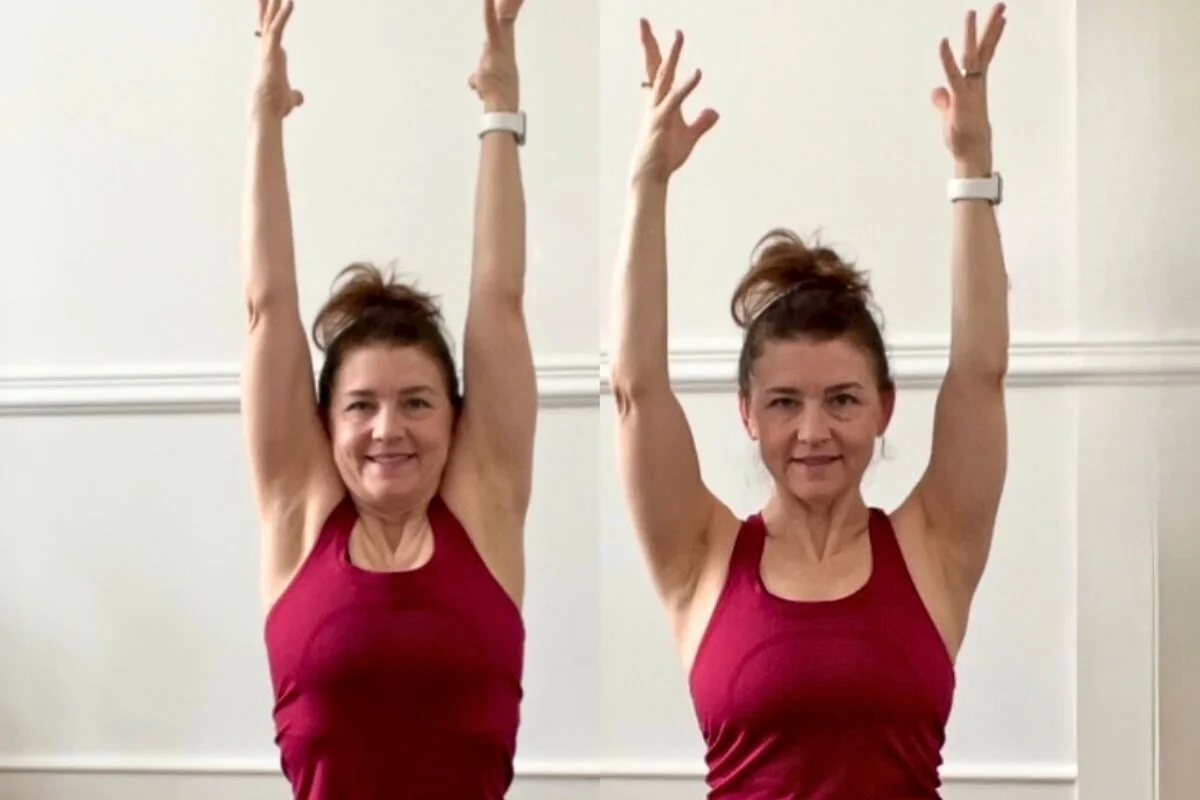
I was midway through teaching Warrior 1 when I noticed it.
A student in the second row had her arms reaching high, but her shoulders were creeping up toward her ears. Beside her, another student had clearly heard the "shoulders down" memo and was straining to pin her shoulder blades to her back while reaching overhead.
Both looked uncomfortable. Neither looked right.
And I realized: the cue I was about to give could help one of them and hurt the other.
Here's what I've learned after 25+ years as a physical therapist and yoga teacher: the answer to "shoulders up or down?" is actually neither. The real issue is that most yoga teachers are confusing two completely different movements.
Understanding the difference between shoulder blade rotation and shoulder blade elevation will change how you think about this cue forever.
In This Article:
Why "shoulders down" causes so much confusion
The difference between scapular rotation and elevation (with visuals)
Why stress makes shoulders creep up
What to cue instead of "slide your shoulders down your back"
The Source of All the Confusion
Here's what typically happens:
A teacher sees a student's shoulders bunched up by their ears in Downward Dog or Warrior 1. It looks tense. It looks wrong. So they cue: "Slide your shoulders down your back" or "Pull your shoulders away from your ears."
The student complies, yanking their shoulders down while their arms are still overhead.
Problem solved? Not quite.
Then another teacher comes along and says, "Wait, that's harmful! The shoulders need to go up when the arms go overhead. Let them rise!"
Now we have two camps. Two opposing cues. And a whole lot of confused teachers caught in the middle.
The real issue? Both camps are talking about different movements and using the same language.
Two Different Movements, Same Body Part
To clear this up, you need to understand that your shoulder blades (scapulae) can move in several different ways. The two that matter most here are:
Elevation and depression (up toward your ears and down away from them)
Rotation (upward and downward)
These are not the same thing.
Elevation and Depression: The Movements You Already Know
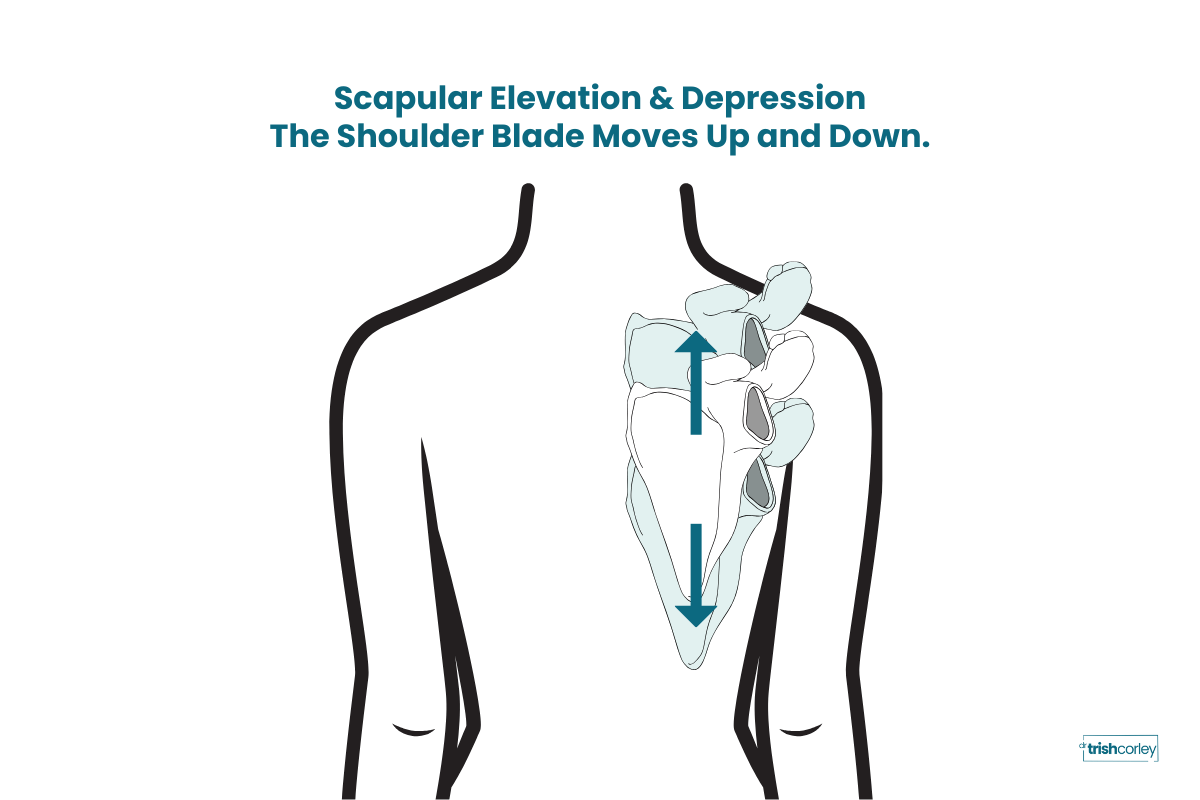
Elevation is when your entire shoulder blade slides upward along your rib cage, like when you shrug your shoulders up to your ears.
Depression is when your shoulder blade slides downward along your rib cage, like when you forcefully press your shoulders down.
These are sliding motions, straight up or straight down. And this is what most people picture when they hear "shoulders up" or "shoulders down."
But here's where it gets interesting.
Scapular Rotation: The Movement Most Yoga Teachers Miss
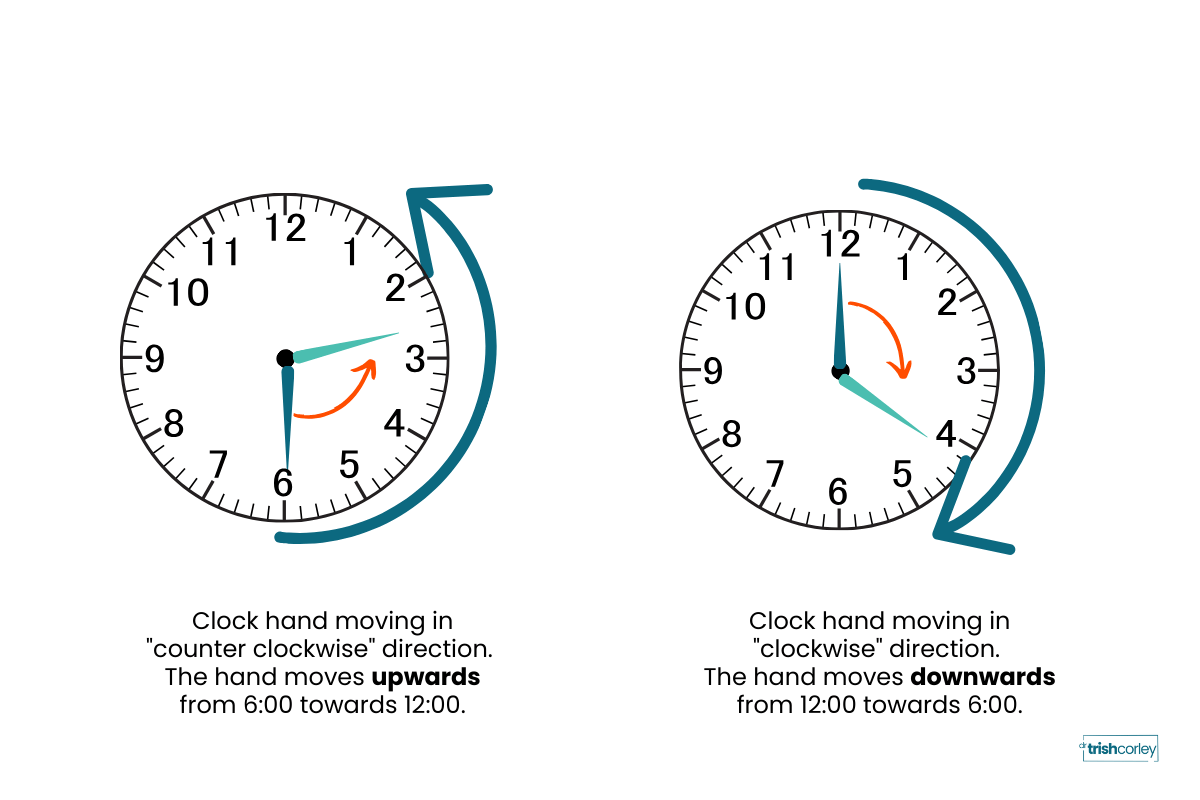
Think of your shoulder blade like the hand of a clock.
When a clock hand moves counter-clockwise, it sweeps upward from 6:00 toward 12:00. That's similar to upward rotation of your shoulder blade.
When a clock hand moves clockwise, it sweeps downward from 12:00 toward 6:00. That's similar to downward rotation of your shoulder blade.
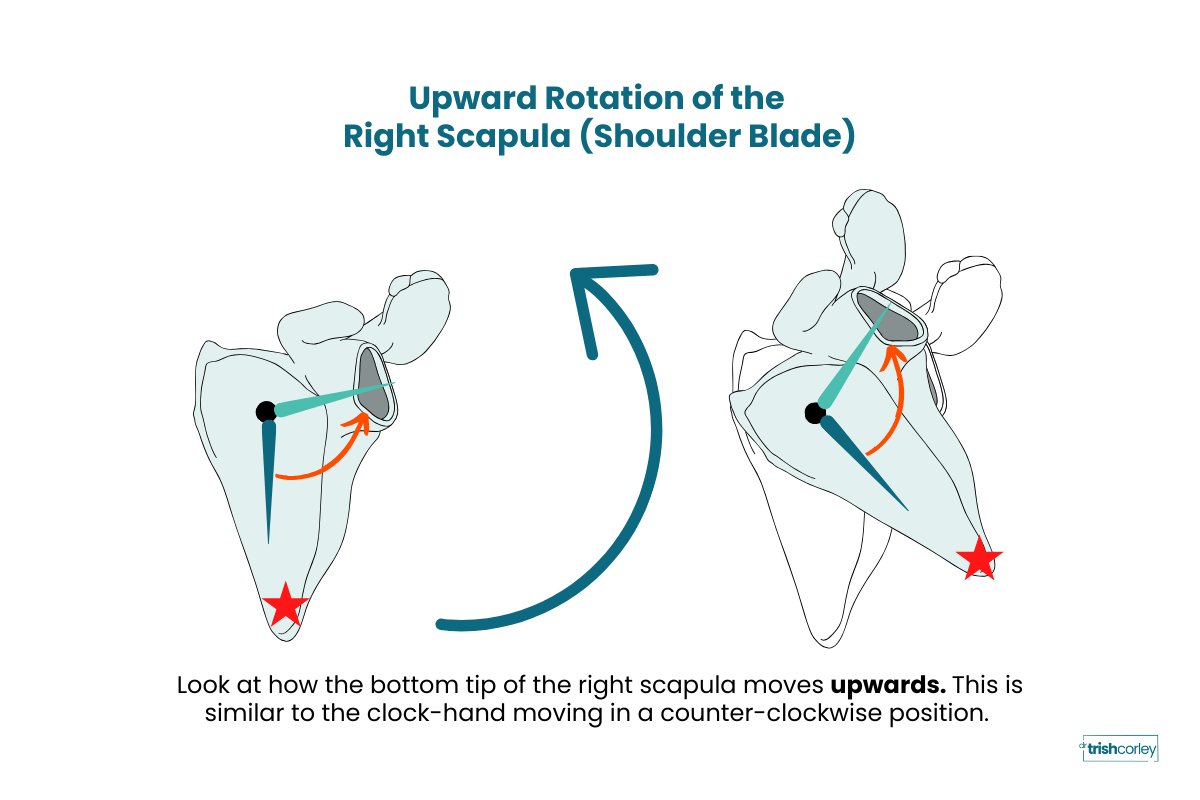
Upward rotation is what happens automatically when you lift your arm out to the side and overhead. The bottom tip of your shoulder blade rotates outward and slightly up. This coordinated movement, called scapulohumeral rhythm, is essential for healthy shoulder mechanics. You can't get your arm fully overhead without it.
Downward rotation is what happens when you lower your arm back down. The shoulder blade rotates back to its resting position.
Here's the key: during rotation, the shoulder blade is turning, not traveling up or down. The base of the shoulder blade stays relatively stable against your rib cage, just like the center of a clock stays fixed while the hand rotates around it.
Why This Distinction Matters
Elevation and depression are sliding motions.
Rotation is a turning motion.
They're completely different. And this is exactly where the confusion around shoulder cues begins.
Where Teachers Get Lost
Here's where the confusion happens:
Many teachers hear "upward rotation" and think it means the shoulders go up. So they assume that when someone says "don't pull your shoulders down," they mean "let your shoulders elevate toward your ears."
That's not what's happening.
Upward rotation and elevation are different movements.
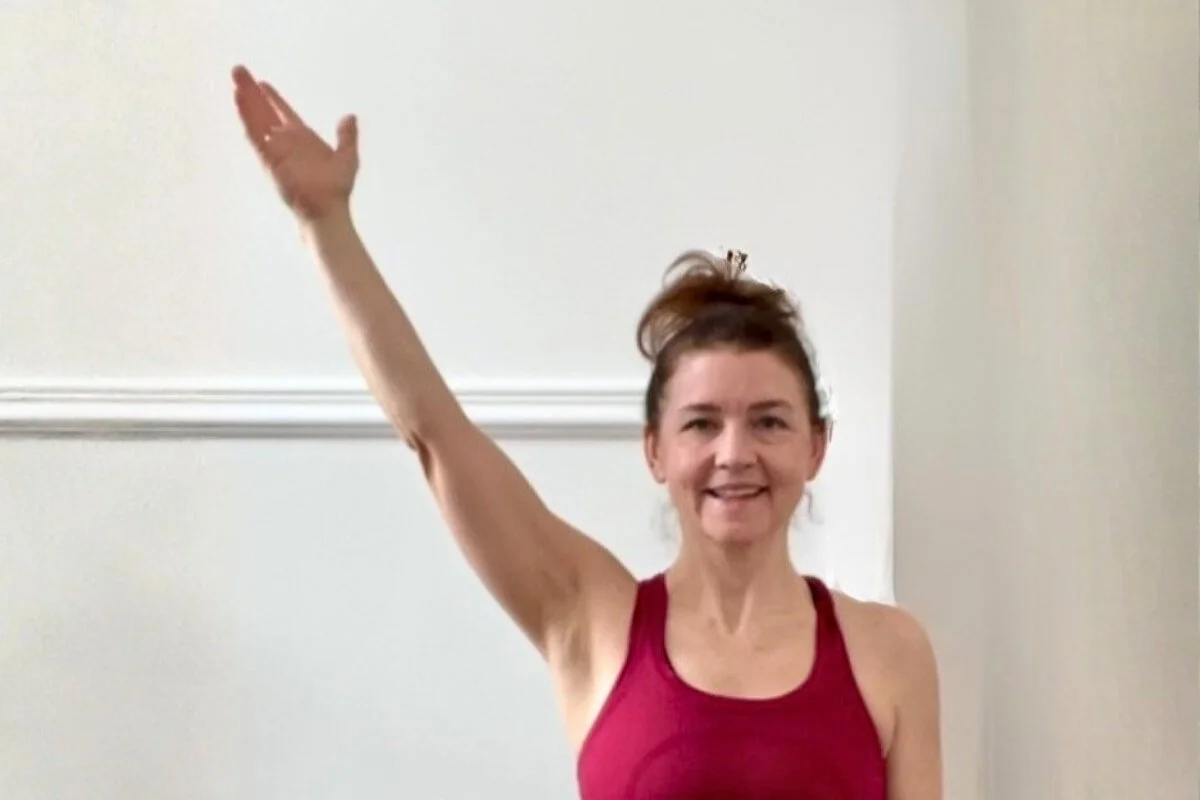
When your arm goes overhead:
Your shoulder blade should rotate upward (this happens automatically)
Your shoulder blade should stay in a relatively neutral position, not elevating toward your ears or depressing down your back
The problem isn't that the shoulder blade is rotating. The problem is when the shoulder blade is also elevating or depressing excessively.
Why Shoulders Creep Up Anyway
So if the shoulder blade naturally rotates without needing to elevate, why do so many students end up with their shoulders by their ears?
The short answer: stress.
The upper trapezius is the muscle on the top and back of your shoulder that connects to your neck. You know it well. It's the one that gets tight and achy, the one that begs for a massage after a long day.
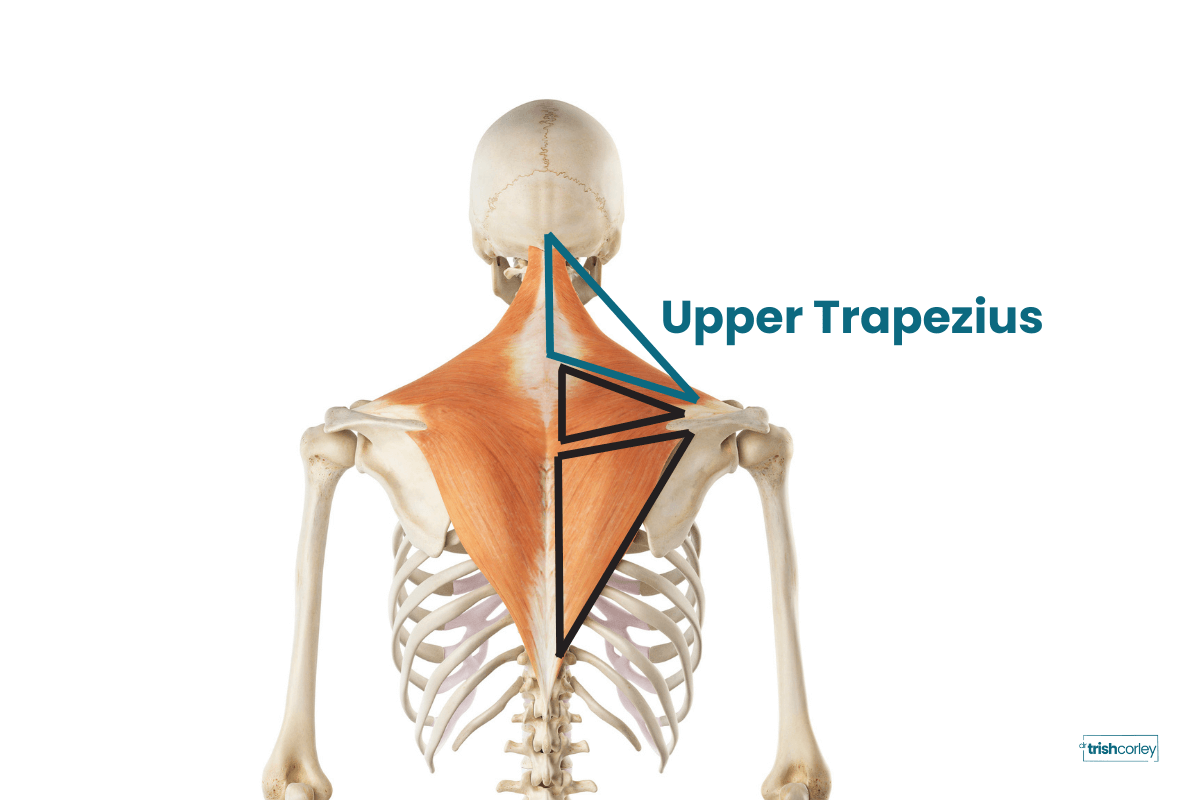
One of its jobs? Elevate the shoulder blade.
Think about your body's reaction to stress, surprise, or anxiety. Your shoulders come up. That's your upper trapezius responding. And research confirms that mental stress significantly increases trapezius muscle tension, even without any physical load.
When this muscle is chronically overworked (and for most of us, it is), it tends to jump in during overhead movements when it shouldn't be doing all the work. The result? Elevation creeps in alongside rotation.
There's more to the story here, involving how multiple muscles need to coordinate for smooth shoulder mechanics. But the key point is this: what you're seeing when shoulders creep up isn't a rotation problem. It's a muscle recruitment problem. And that's where understanding anatomy gives you a real advantage as a teacher.
When "Shoulders Down" Backfires
The "shoulders down" cue made sense as a response to what teachers were seeing. But it got applied universally instead of situationally.
When a student with elevated shoulders hears "bring your shoulders away from your ears," it can help. The cue encourages relaxation.
But when a student whose shoulders are already in a good position hears this cue? They force their shoulders into depression, working against their body's natural mechanics.
Neither extreme is ideal. Repeated depression with overhead movement can cause problems, just like repeated elevation. The shoulder blade needs freedom to rotate without being yanked in either direction.
The Bottom Line
Shoulder blade elevation is not the same as shoulder blade upward rotation. And shoulder blade depression is not the same as downward rotation. When you understand this distinction, the confusion around shoulder cues starts to dissolve. The goal isn't to force the shoulders up or down. It's to allow natural rotation while keeping the shoulders in a neutral position, away from the ears, without strain.
A More Empowering Approach
So what do you actually cue?
Here's what I've found works: "Keep your shoulders away from your ears."
Notice this is different from:
"Pull your shoulders down your back" (which can create excessive depression)
"Let your shoulders come up to your ears" (which can reinforce elevation patterns)
"Keep your shoulders away from your ears" invites space without force. It doesn't ask for an extreme in either direction.
If someone's shoulders are elevated: Encourage relaxation. Breathing exercises can help. You might say, "Soften the muscles at the base of your neck" or "Create a little space between your ears and shoulders."
If someone's shoulders are forced down: Invite them to relax and let the shoulders rest more naturally. Say, "Ease up on pressing your shoulders down. Let them float."
The art of cueing is understanding why you're saying what you're saying. When you speak to someone's body, you're speaking to their anatomy and biomechanics. That's both exciting and a responsibility.
Get Curious! Q&A
Should you pull your shoulders down when your arms are overhead in yoga?
Not necessarily. While the "shoulders down" cue can help someone whose shoulders are shrugged up toward their ears, applying it universally can cause excessive shoulder blade depression. The goal is a neutral position, not forced in either direction.
Why do shoulders shrug up during overhead movements?
Often, it's related to an overactive upper trapezius muscle, which is closely tied to stress responses. When this muscle dominates during overhead movements, elevation occurs alongside rotation.
What's the difference between shoulder blade rotation and shoulder elevation?
Rotation is a turning motion where the bottom tip of the shoulder blade moves outward, allowing the arm to reach overhead. Elevation is a sliding motion where the entire shoulder blade moves up toward the ear. Both can happen at the same time, but they're distinct movements.
How does stress affect shoulder position in yoga?
Stress triggers the upper trapezius to contract, pulling the shoulders toward the ears. Over time, this pattern becomes habitual, and the muscle over-recruits during movements like lifting the arms overhead.
What's a better cue than "slide your shoulders down your back"?
Try "keep your shoulders away from your ears" or "create space between your ears and shoulders." These cues invite a neutral position without forcing depression. For someone already in a good position, no shoulder cue may be needed at all.
Go Deeper with Anatomy
Here's what I didn't cover in this post: which muscles need to coordinate for healthy shoulder mechanics, why some students can't seem to change their patterns no matter how you cue them, and how to address the underlying issues, not just the symptoms.
That's the difference between knowing a concept and being able to teach from it.
Inside the Enlightened Anatomy Course, I break down the anatomy that actually changes how you teach, including the shoulder mechanics that make postures like Downward Dog and Warrior 1 click for your students.
Learn more about Enlightened Anatomy →
References
Kibler WB, Ludewig PM, McClure PW, Michener LA, Bak K, Sciascia AD. Clinical implications of scapular dyskinesis in shoulder injury: the 2013 consensus statement from the 'Scapular Summit.' British Journal of Sports Medicine. 2013;47(14):877-885. Read on PMC
Lundberg U, Kadefors R, Melin B, et al. Psychophysiological stress and EMG activity of the trapezius muscle. International Journal of Behavioral Medicine. 1994;1(4):354-370. Readon PubMed
About the Author
Dr. Trish Corley is a Doctor of Physical Therapy (Physiotherapy) and yoga teacher trainer with over two decades of clinical experience. She helps yoga teachers learn anatomy, give clear cues, and create classes their students love. Based in Lisbon, Portugal, she leads the Enlightened Anatomy Course, the Elevate Your Impact Mentorship, and the Power to Lead 200-Hour YTT.