
Should You Lock Your Knees in Yoga? A Physical Therapist’s Perspective
There I was, deep in a standing forward fold with my hands wrapped around my heels, listening to the yoga teacher say "lock your knees, lock your knees, lock your knees."
With each repetition of the cue, I pushed the backs of my knees further toward the back of the room. My focus wasn't on what I was feeling. It was on whether my knees were locking. To me, "lock your knees" meant keep moving until my joints couldn't move anymore. Until they were locked.
I was pretty new to yoga at the time. And despite being an expert in human movement with a strong understanding of biomechanics, I listened to the teacher. I interpreted their words to mean extend my knees as much as possible. New to yoga, I trusted them and did what they said.
Here's what I've learned after 25 years as a Doctor of Physical Therapy and yoga teacher: the cue "lock your knees" isn't inherently dangerous, but it's frequently misunderstood. When students hear this cue, they often push into hyperextension and rely on passive structures (ligaments and bones) rather than engaging the muscles around the knee. The real issue isn't potential knee damage. The real issue is that you miss out on the opportunity to build strength and stability.
In This Article:
What "lock your knees" actually means (and why it's confusing)
The anatomy of knee extension vs. hyperextension
Why hyperextension isn't as scary as you've been told
What to say instead of "lock your knees"
How to build strength and stability around the knee joint
Where Did This Cue Come From?
As my practice evolved and I started teaching, I began paying more attention to the cueing around me. And I started asking what I believe is the most important question: Why?
Why should I lock my knees in yoga? The more I thought about it, the more I realized I wasn't sure what teachers actually meant by "lock your knees."
I like to assume that somewhere in the history of yoga, a teacher had good intentions and started saying "lock your knees." And then, whether it was an effective cue or not, other teachers started using it too. Cues get passed down from one teacher to the next.
Unfortunately, cues often get passed down without understanding why they're used.
The Anatomy of Knee Extension
To understand what's happening when we "lock" our knees, it helps to understand some basic anatomy.
Joints are where two or more bones meet, allowing movement and providing mechanical support. They're stabilized by a combination of ligaments, tendons, and muscles.
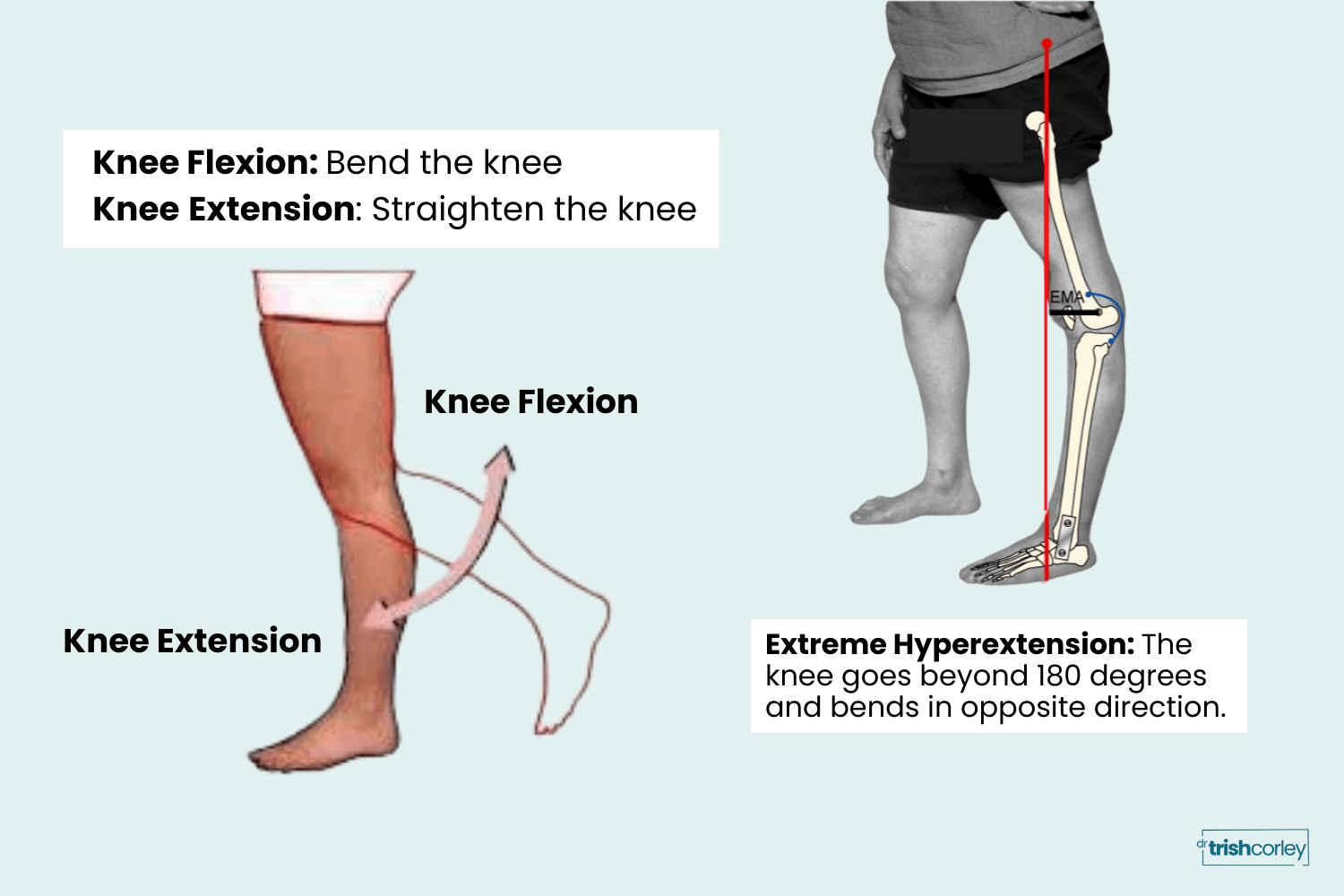
The knee is a modified hinge joint, primarily allowing flexion (bending) and extension (straightening), with a small amount of rotation. It's supported by strong ligaments like the anterior cruciate ligament (ACL) and muscles like the quadriceps (front of thigh) and hamstrings (back of thigh).
Here's the key terminology:
Flexion: When the knee is bent
Extension: When the knee is straight
Hyperextension: When the knee extends beyond 180 degrees (beyond straight)
Is Hyperextension of the Knee a Problem?
Here's where I want to offer some reassurance.
Many people have increased laxity in their ligaments and can simply extend their knees beyond straight. This in itself is not a problem. There's no need to freak out if you experience or see hyperextension of the knees during yoga practice. Hyperextension exists in many healthy individuals, including professional athletes.
So why do I avoid using the cue "lock your knees in yoga"?
When students push into hyperextension, they do place unnecessary stress on the ligaments and posterior capsule of the knee. Over time, that stress could lead to further instability. But honestly? That's not my primary concern.
I'm more concerned about the missed opportunity.
When you hang out in hyperextension, you're relying on passive structures (ligaments, joint capsules, bones) to hold you up. You don't have to use your muscles. And that means you miss out on building strength and stability around the knee joint.
You miss out on getting to use your muscles.
The Cue Isn't the Problem. Misinterpretation Is.
When students hear "lock your knees in yoga," they often interpret it as pushing the joint to maximum extension and relying on passive structures rather than engaging the surrounding muscles. This diminishes the active muscular engagement necessary for stability and strength.
But here's the thing: I think the original intent behind this cue was actually good. The teachers who started using it were likely trying to encourage isometric contraction of the muscles around the knee.
Isometric contractions occur when muscles generate force without changing length. The muscle fibers contract, but the joint stays stable. When muscles on either side of the knee contract at the same time, it creates a stabilizing effect. This approach builds strength and supports joint stability.
The problem is that "lock your knees" doesn't communicate that intention clearly.
A More Empowering Approach
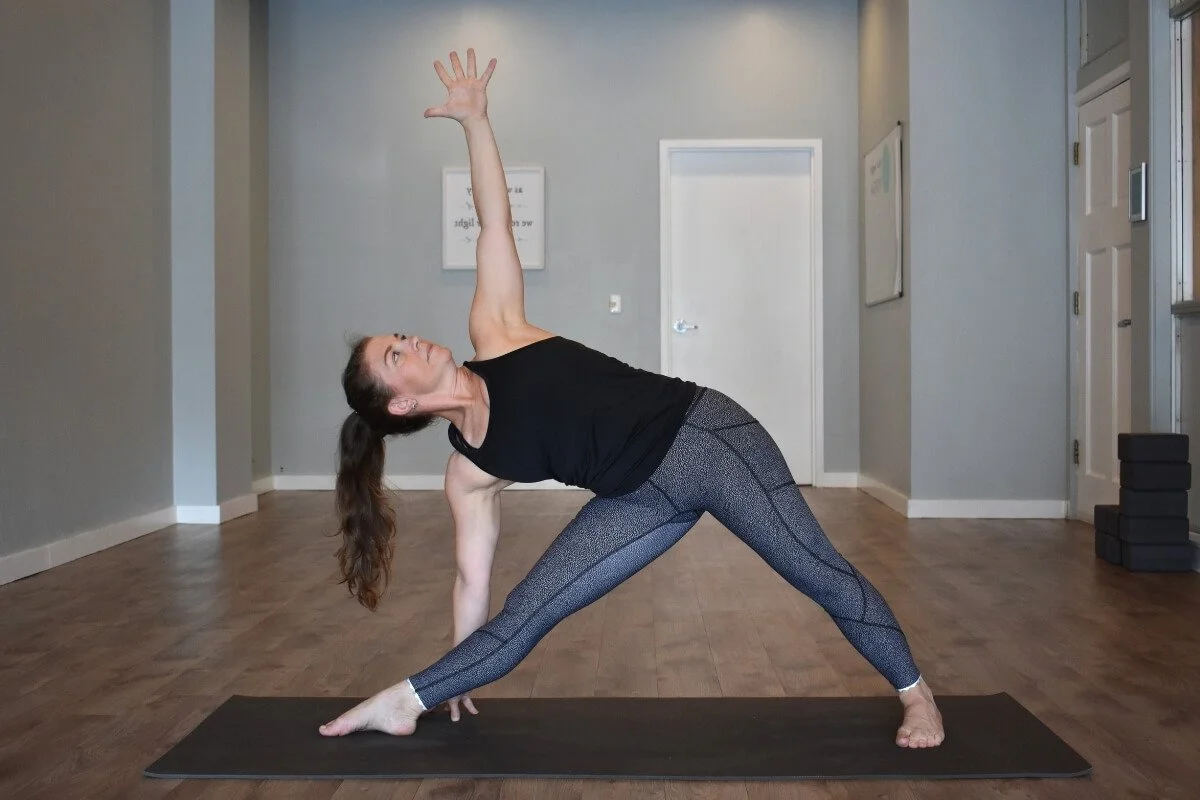
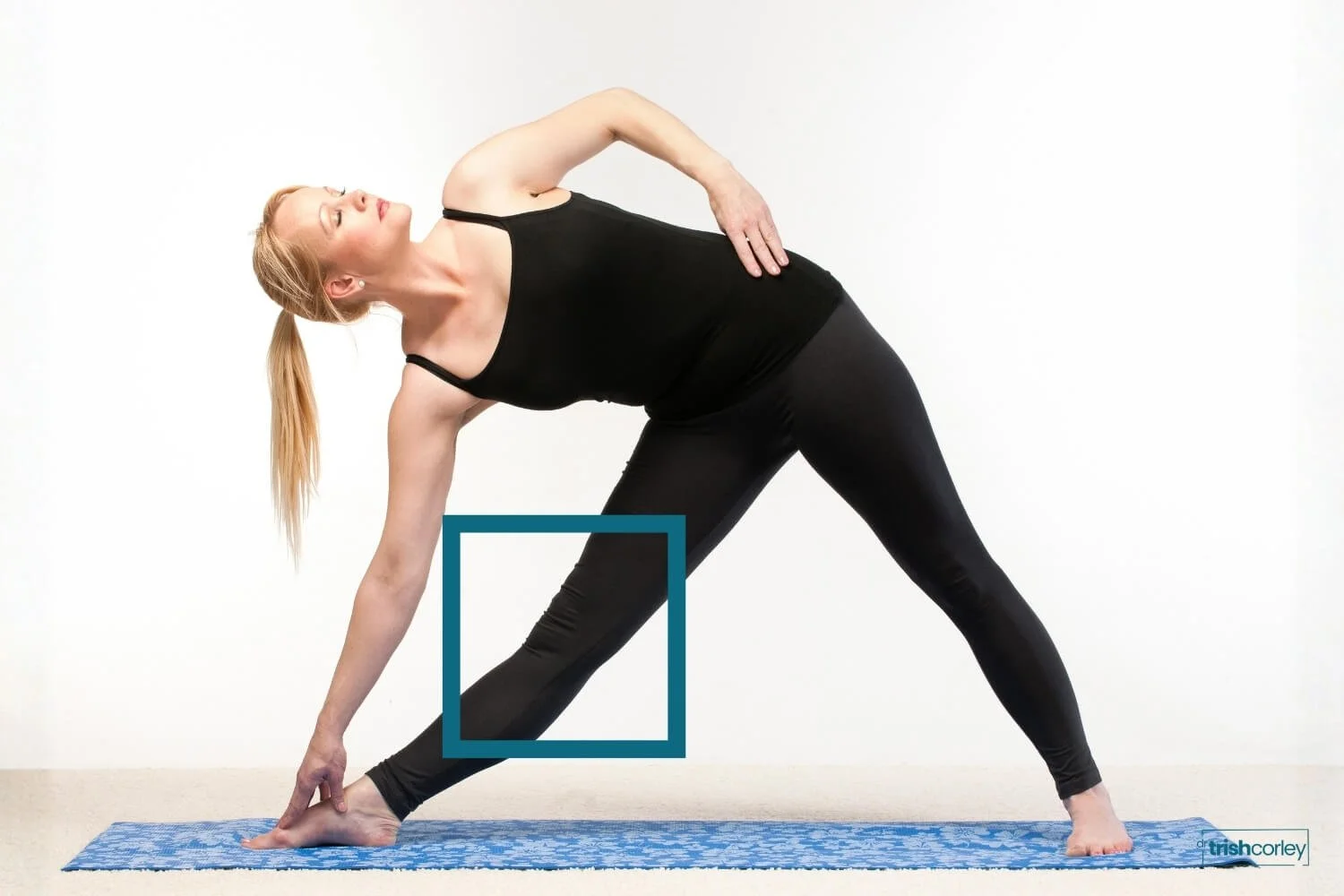
In postures like Tadasana (Mountain) or Trikonasana (Triangle), rather than pushing your knees back into hyperextension, the goal is to engage the muscles on either side of the joint: the quadriceps (front of thigh) and hamstrings (back of thigh).
But here's the challenge: simply saying "engage your quadriceps and hamstrings" doesn't help most students. They won't know what to do with that cue. Just like they might get confused when you say "lock your knees," they get confused with the cue to "engage."
Clear and specific cues are necessary.
There isn't just one good cue to use. The best cue depends on the posture and the individual. That said, when I observe students with hyperextension of the knees, I usually say:
"Micro-bend your knee" or "Put a very small bend in your knee."
This often leads to activation of the hamstrings (to create the bend) and the quadriceps (to control the bend). Both muscle groups engage, creating stability around the joint.
A note on micro-bending: Some teachers argue that a micro-bend is just "buckling" the knee. I'd push back on that. The micro-bend isn't the end goal. It's a tool to help you find muscular engagement. Once you feel the muscles activate, you can work toward straightening the leg while maintaining that engagement. The micro-bend helps you get out of passive hanging and into active stability.
The Bottom Line
The cue "lock your knees" isn't dangerous, but it's confusing. And when students misinterpret it, they miss the opportunity to build strength and stability around the knee joint. Instead of relying on ligaments and bones, focus on engaging the muscles around your knee. A micro-bend can help you find that engagement.
With any cue, the key is understanding the intention behind it and noticing how it lands in your body. If a cue doesn't make sense to you, ask why. And if you're a teacher, watch how your cues land in your students' bodies. That feedback is everything.
Get Curious! Q&A
Is locking your knees in yoga bad for you?
Not necessarily. Hyperextension exists in many healthy individuals and isn't inherently harmful. The bigger concern is that when you "lock" into hyperextension, you rely on passive structures (ligaments and bones) instead of actively engaging the muscles around your knee. You miss the opportunity to build strength and stability.
What does "lock your knees" actually mean?
The original intention was likely to encourage muscular engagement and stability around the knee joint through isometric contraction. However, most students interpret it as pushing the knee into maximum extension (hyperextension), which creates the opposite effect: passive hanging on ligaments rather than active muscle engagement.
What's the difference between a straight leg and a hyperextended knee?
A straight leg has the thigh bone and shin bone aligned at approximately 180 degrees. A hyperextended knee goes beyond 180 degrees, creating a slight backward curve. Some people naturally have more range here due to ligament laxity. The key is whether you're actively engaging muscles or passively resting on joint structures.
What should I say instead of "lock your knees"?
Try "micro-bend your knee" or "put a very small bend in your knee." This encourages activation of the hamstrings and quadriceps, creating stability around the joint. You can also try "feel the muscles around your knee hug the joint" or "find a straight leg without pushing back."
Should I micro-bend my knees in every yoga posture?
Not necessarily in every posture, but it's a useful tool when you notice yourself pushing into hyperextension. The micro-bend isn't the end goal. It helps you find muscular engagement. Once you feel the muscles activate, you can work toward straightening while maintaining that engagement.
Go Deeper with Cueing
If this made you rethink "lock your knees," you're going to love my upcoming training.
Cue with Clarity is a 4 week training for yoga teachers.
Teach any class without doubt because you trust your ability to cue, observe, and adjust.
Learn More and about Cue with Clarity →
Want to start learn some anatomy informed cues you can use right away? My free guide, Cue with Confidence, shows you how anatomy-informed cueing builds trust with your students.
About the Author
Dr. Trish Corley is a Doctor of Physical Therapy (Physiotherapy) and yoga teacher trainer with over two decades of clinical experience. She helps yoga teachers learn anatomy, give clear cues, and create classes their students love. Based in Lisbon, Portugal, she leads the Enlightened Anatomy Course, the Elevate Your Impact Mentorship, and the Power to Lead 200-Hour YTT.