
Can You Teach the Same Yoga Sequence Every Class? (Yes, and Here's Why)
My first real teaching experience was with a set hot yoga sequence. Same postures, same order, every class. And honestly? It was a gift. I didn't have to worry about creating something new each time. I just showed up, taught the sequence I knew, and got really good at actually seeing the students in front of me.
But over time, I started to feel its limits. Different students, different bodies, different time slots, private clients with specific needs. The sequence never changed, and sometimes the class needed it to.
Then I found two teachers, Nancy and Roger, whose classes I couldn't get enough of. There was something about the consistency of their teaching that kept pulling me back. Every class felt familiar but never boring. I didn't understand why until I went to my Level 1 training with Baron Baptiste and had a moment: what I'd been practicing with Nancy and Roger this whole time was a set, written sequence. Journey Into Power.
I had no idea.
And here's what that means for you: your students may not even realize you're teaching the same sequence, especially when you're so rooted in it that you have the freedom to be creative within it.
Yes, you can teach the same yoga sequence every class, and it might actually make you a better teacher. When you know your sequence deeply, you stop worrying about what comes next and start actually seeing your students. As a doctor of physical therapy and yoga teacher trainer with over 25 years of experience, I've built my entire teaching career on this principle: one sequence, deeply known, yields infinite possibilities.
In This Article:
Why creating new sequences every class might be holding you back
What happens when you know your sequence deeply
How one sequence adapts to every student (including cancer rehabilitation)
How to find and commit to your sequence
The Pressure to Create New Yoga Sequences Every Class
If you teach yoga, you've probably felt this: the pressure to show up with something fresh every single time. A new flow. A creative peak posture. Something your students haven't seen before.
And when the creativity doesn't come? Stress. Self-doubt. That sinking feeling the night before class when you still don't have a plan.
Here's what I've noticed after teaching hundreds of classes across more than 40 cities: the teachers who are most present, most connected, and most creative in the room aren't the ones inventing new sequences every week. They're the ones who know their sequence so well that they're free to actually teach.
Three Approaches to Yoga Sequencing (and What Actually Works)
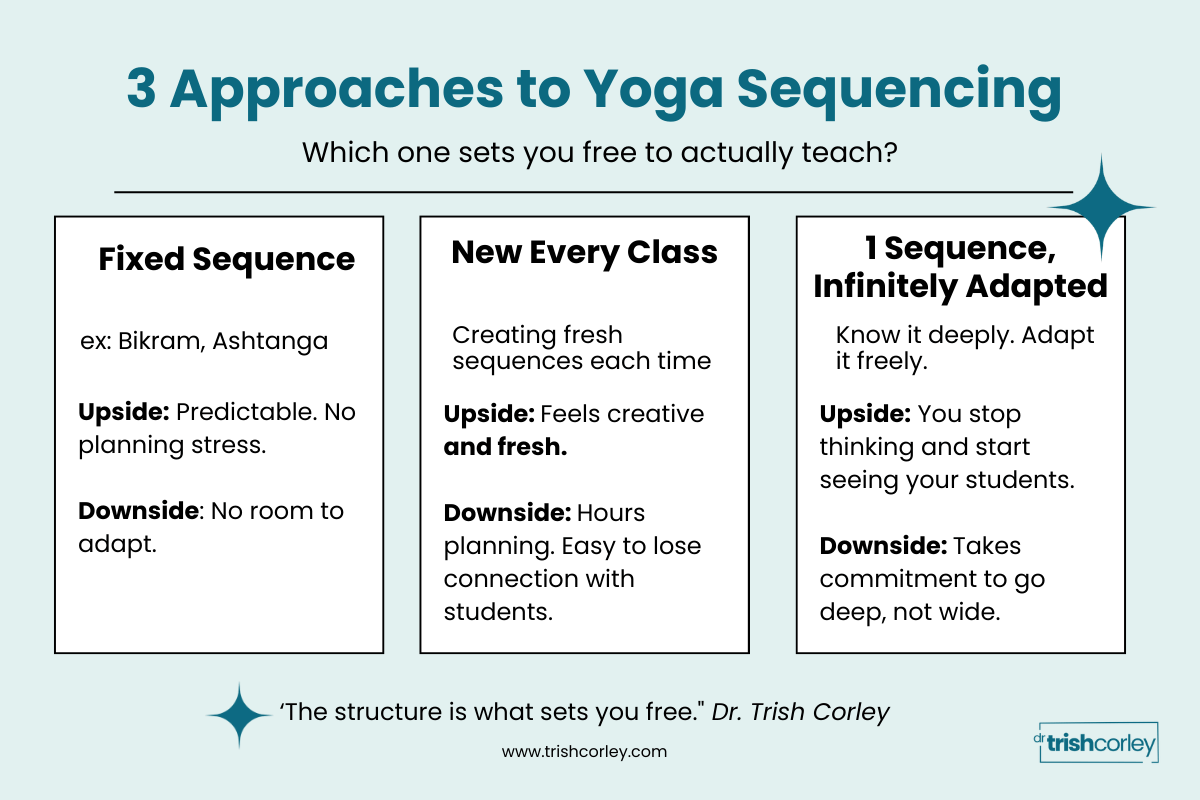
There are generally three ways yoga teachers handle sequencing, and each has trade-offs.
Fixed sequences like Bikram (Hot 26) and Ashtanga Vinyasa give you the same practice every time. Students appreciate the consistency. Teachers never scramble for a plan. The potential downside? If you're not intentional, it can start to feel like you're going through the motions.
Brand-new sequences every class keep things fresh on the surface. But have you ever been in a class where the teacher was so focused on remembering their creative sequence that they seemed completely disconnected from the room? Too much focus on what comes next can pull you away from what's happening right now.
Spontaneous, in-the-moment sequencing sounds ideal. Read the room, respond intuitively. But this requires a deep understanding of both the practice and the people in front of you. It's a hard place to start.
In my experience, the most creative, connected teaching comes from a balanced approach that starts with structure.
What Happened When I Committed to One Sequence
The Journey Into Power sequence is made up of over fifty yoga postures grouped into 11 mini-sequences. From my perspective as a physical therapist, it's a sound sequence with attention to the full body. I trust it. And I continue to use it as the foundation of my teaching.
But what makes it different from that first hot sequence I taught is that it's intended to be malleable. The structure is set, but it's designed to be adapted. Different themes, different emphasis, different students, same foundation.
The more I taught it, the less I had to think about what came next. And the less I thought about what came next, the more I could actually be in the room.
I'm not the only one who's experienced this shift. Melody, a yoga teacher and graduate of my Elevate Your Impact Mentorship, described it perfectly: "I always used to believe that in order to be a good yoga teacher, I had to have like a million sequences in my back pocket. This really opened my eyes. I could master one sequence and be so much more aware of what's actually happening in the room rather than what's going on in my head. That took a lot of pressure away."
Why a Set Sequence Makes You More Creative (Not Less)
Think about walking your favorite streets in a city you know well. You already know the route, so you can really look around. You notice things. You take it all in.
When I first moved to Lisbon, Portugal, I spent just as much time staring at Google Maps as I did observing what was around me. I didn't feel truly present yet.
Teaching from a set sequence works the same way. When you're not worried about remembering what comes next, you can create a new theme. You might focus on adding backbends, explore a yoga philosophy, or dial in on one body part. You can change the sequence to meet your students' needs or the constraints of time.
The structure is what sets you free.
One Sequence Adapted to Every Student
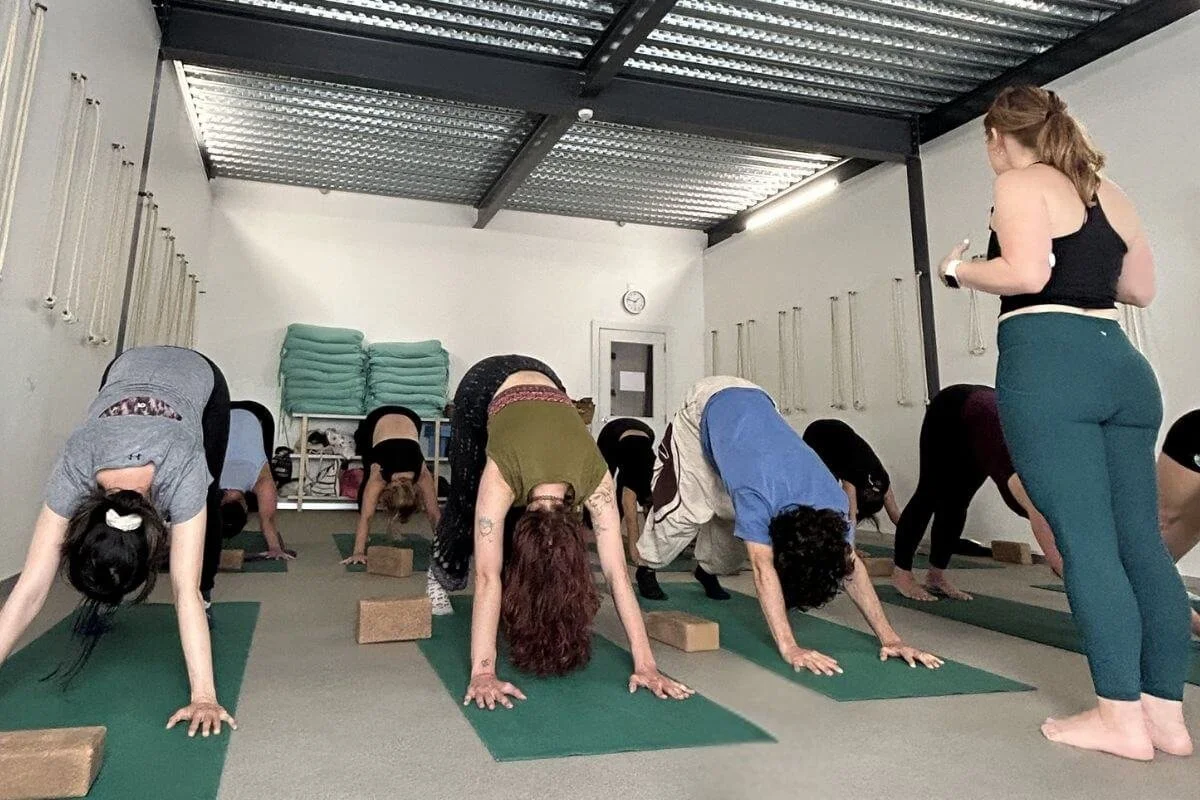
Does one sequence work for everybody? Not exactly, but also... yes.
After teaching the Journey Into Power sequence at a studio for a while, I started teaching private yoga. Most of my clients came to me because they wanted to start a practice but had concerns about injuries or physical limitations.
What I found surprised me. Rather than creating a new sequence for each person, I adapted the one I already knew.
While working as a physical therapist at the Touro Infirmary Cancer Rehabilitation Center in New Orleans, I often used yoga as a modality for therapeutic healing. Some patients had just had surgery and were in pain. Some had chemotherapy ports. Some were dealing with lymphedema. Some couldn't get on the floor, and some couldn't stand.
And you know what I did? I started with the sequence I knew and adapted it to meet their needs. The sequence ended up looking very different every time, but I never had to worry about creating something from scratch for each person.
One sequence. Infinite possibilities.
How to Find Your Sequence
If you're feeling lost about yoga sequencing, you don't have to keep struggling with the pressure to create something new every class. Here's what helps:
Find a sequence that inspires you. One that leaves your body feeling great and that you trust.
Teach it. Again and again. Get acquainted with it. Notice what happens when you stop thinking about what comes next.
Find your creativity within it. The adaptations, the themes, the moments of connection with your students. That's where the real creativity lives.
The Bottom Line
Teaching the same yoga sequence every class isn't lazy. It's strategic. When you know your sequence deeply, you're free to be present, creative, and genuinely responsive to the people in front of you. Structure doesn't limit your teaching. It's the foundation that makes great teaching possible.
Get Curious! Q&A
Won't my students get bored if I teach the same sequence?
When you're deeply connected to your sequence, your teaching evolves even when the postures don't. Your cues get sharper, your observations get deeper, and your students feel that presence. The experience changes every class because YOU change within it.
What if I don't practice Baptiste or power yoga?
This principle works regardless of style. Whether you teach vinyasa, hatha, or yin, the concept is the same: find a structure you trust, learn it deeply, and let your creativity come from within that structure rather than from reinventing it.
How long does it take before a set sequence feels natural?
It varies, but most teachers start feeling the shift after consistently teaching the same sequence for about 4 to 6 weeks. That's when you notice you're spending less energy remembering and more energy connecting.
Can I modify a set sequence for students with injuries or limitations?
Absolutely. That's one of the biggest benefits. When you know your sequence inside and out, you can adapt it in the moment without losing the thread of the class. I've adapted the same sequence for students in chairs, for people recovering from surgery, and for athletes training at peak levels.
What if I get bored teaching the same sequence?
If boredom creeps in, it's usually a sign to go deeper, not wider. Challenge yourself to refine one section, explore new cues for a familiar posture, or add a thematic focus. The sequence stays the same. Your relationship with it keeps growing.
Ready to Build Real Teaching Confidence?
Sequencing is just one of six pillars that build genuine teaching confidence. If this article resonated with you, the Elevate Your Impact Mentorship goes deeper into all of it: sequencing, cueing, alignment, mindset, authentic voice, and student connection.
It's a mentorship designed for yoga teachers who are ready to stop second-guessing and start teaching with real authority.
About the Author
Dr. Trish Corley is a Doctor of Physical Therapy (Physiotherapy) and yoga teacher trainer with over two decades of clinical experience. She helps yoga teachers learn anatomy, give clear cues, and create classes their students love. Based in Lisbon, Portugal, she leads the Enlightened Anatomy Course, the Elevate Your Impact Mentorship, and the Power to Lead 200-Hour YTT.