
Why I'm Obsessed With Journey Into Power Sequence
Picture this: Houston, Texas. Yoga One Studios circa 2010. I'm not yet a yoga teacher, just a regular practitioner who has fallen in love with the practice. There are a handful of teachers I'll take from, but two stand out. Roger and Nancy. Their classes pull me back week after week.
Every class feels different. Different focus, different tone, different invitation. And every time I land in Savasana, I notice the same thing. My body feels altered. Not just relaxed. Reorganized. Settled into itself in a way that doesn't happen in every yoga class I take.
It would be a long time before I realized that Roger and Nancy were teaching the same sequence every single class. Same postures. Same order. Same structure. I just couldn't see it, because they made the experience feel new every single time.
The sequence was Journey Into Power.
Why Journey Into Power works comes down to this: it's a sequence that holds up under every lens I've tested it through. As a longtime student, I felt the shift in Savasana every time. As a Doctor of Physical Therapy designing a sequence from a completely different starting point, I built something remarkably close to it. And it's the framework underneath every kind of class I teach. That's why I'm obsessed.
In This Article:
The student years that hooked me on Journey Into Power
What I felt in Savasana that other sequences didn't deliver
The 300-hour anatomy assignment that opened my eyes
Why two different starting points led to the same sequence
How knowing the sequence deeply lets you adapt it to anyone
How I use Journey Into Power across every teaching context
How I Found Journey Into Power Without Knowing It
Roger and Nancy were great teachers. That's the simple version. The deeper truth is that they were great teachers teaching the same sequence over and over, and I had no idea.
If you've never experienced this, it sounds boring. Same sequence? Every class? But here's what actually happens. When a teacher knows their sequence so deeply that they no longer need to think about what comes next, they get to be fully present. The room. The energy. The bodies in front of them. The opportunity to teach to something specific that day.
So Roger and Nancy made each class feel new. New theme. New emphasis. New cue that landed for me in a way it hadn't the week before. The sequence was identical. The teaching was alive.
That's the secret many newer teachers miss. Variety doesn't come from choreography. It comes from presence inside a sequence you know deeply.
What I Felt in Savasana That Other Sequences Didn't Deliver
I've practiced a lot of yoga. Across many cities. Many styles. Many lineages. And I'll be the first to say there are wonderful classes everywhere, in every style.
There is, however, something specific that the Journey Into Power sequence does to my body, and I notice it every single time in Savasana.
I feel reorganized. Like every system has been worked, opened, strengthened, and calmed. Like the sequence did exactly what a complete practice does, in the right order, for the right amount of time. I leave class in a different physical and energetic state than when I walked in.
Other sequences feel good. Some feel great. But not every sequence delivers that whole-body, whole-system shift.
Journey Into Power does. Consistently.
I trusted that for a long time without examining why. Then anatomy gave me a way to understand it.
The 300-Hour Teacher Training That Opened My Eyes
By this point in my story, I'd been Baptiste-certified for years. I was leading the anatomy portion of the 200-hour teacher trainings at Yoga One in Houston. My teachers, Albina and Roger, were starting a 300-hour teacher training there, and Albina asked me to design and lead the anatomy component.
I said yes immediately. Then she handed me the course description.
The description was about chakras, koshas, the subtle body, and the five elements. Things that, at the time, I had a passing familiarity with, but not the kind of fluency I had with Western anatomy. My background was muscles, bones, joints, biomechanics. Not energetic anatomy.
I had to figure out how to teach within that frame.
When Western Anatomy Met the Chakras
Here's what I did. Baron Baptiste talked often about the five elements, and I knew the chakras and the elements have a strong relationship. So I could use what I knew as a starting point.
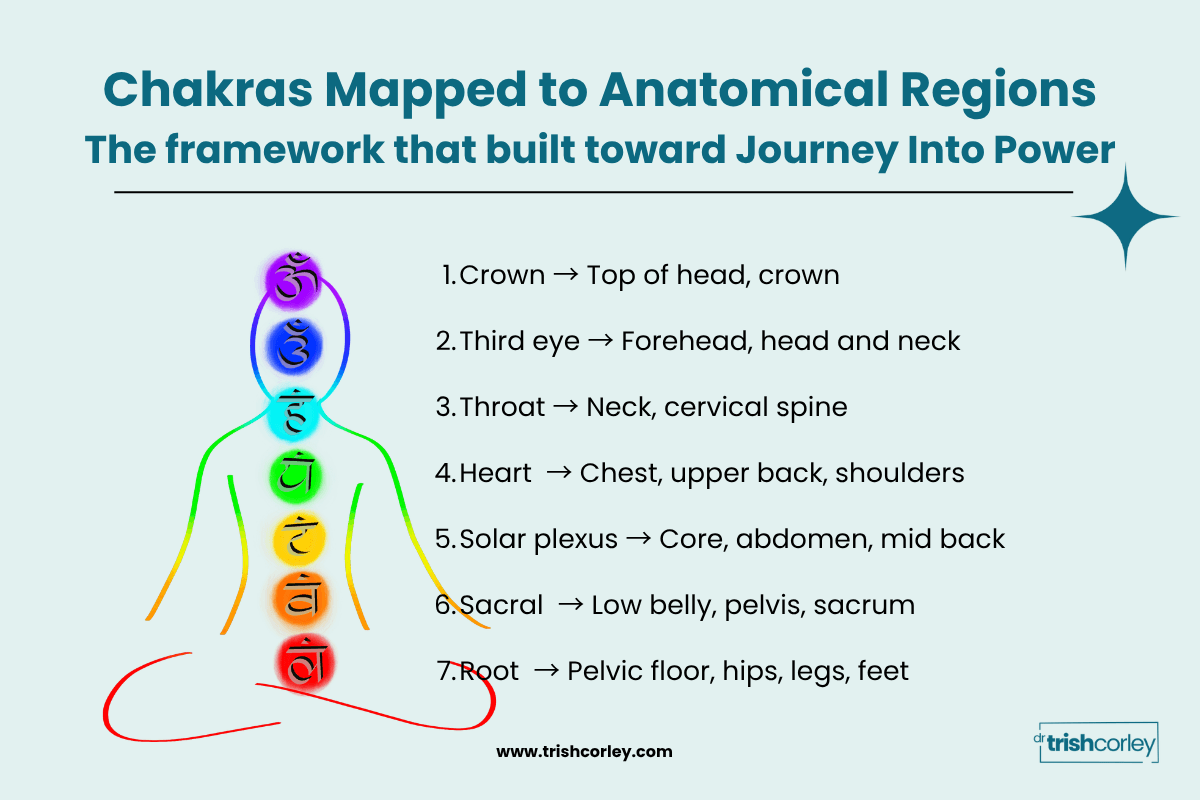
I went chakra by chakra. I explored the qualities of each one. The location in the body. The themes. The energetic intentions.
Then I asked the question that made sense to me as a physical therapist: What muscles and tissues live in this region of the body, and what postures would balance them?
For the root chakra, I looked at the structures of the pelvis, the deep hip muscles, the lower extremities. I chose postures that built stability and grounding in those structures. And I chose postures that lengthened and opened them, so the area would be balanced rather than dominant in one direction.
I worked my way up the body. Sacral chakra, solar plexus, heart, throat, third eye, crown. Region by region. Choosing postures that strengthened the surrounding tissues and postures that lengthened them. Each chakra got a kind of muscular and fascial balance treatment.
Then I sequenced them. Bottom up. Stable foundation first. Activating core and heart. Opening the upper body. Closing with stillness.
I stepped back to look at what I'd built.
It looked a lot like Journey Into Power. Not exactly the same, but quite close. Recognizable. Sequenced around the same fundamental order and structure that Baron Baptiste had created decades before.
Why Two Different Starting Points Led to the Same Sequence
When two different methodologies arrive at a similar outcome, that's worth paying attention to.
Baron designed Journey Into Power with years of study across Iyengar, Bikram, Ashtanga, and his own intuited synthesis. I designed mine from chakras, Western anatomy, and the goal of regional muscular balance. We landed in similar places.
That's not a coincidence. That's a sequence that works.
The sequence works because it's anatomically sound. It works because it's energetically organized. It works because the order moves the body in a way that prepares each phase for the next. And it works because it's adaptable. The structure stays. The expression of it inside that structure is where the teaching lives.
That's why I teach it. That's why I teach it. And it's why the sequence is a core foundation of the 200-hour teacher training I lead.
How Knowing the Sequence Deeply Lets You Adapt It to Anyone
Here's the part that often gets missed. When you know a sequence deeply, you stop being bound by it. You become free inside of it.
The same Journey Into Power sequence I teach to a room full of seasoned practitioners is the sequence I take into a private session with someone recovering from hip replacement surgery. The structure is the same. The expression is entirely different.
That's possible because once you understand why each phase exists and what it's doing for the body, you can flex the expression of every posture to meet the person in front of you. Slow it down. Speed it up. Shorten holds. Lengthen them. Modify the postures themselves. Replace one variation with another that works for that body, on that day.
The sequence stops being a script you have to follow and becomes a framework you can move within.
That's also why it never feels boring. The sequence is the same. The teaching is always responsive to what's actually in the room.
How I Use Journey Into Power Across Every Teaching Context
Unless I'm specifically teaching another method like Rocket Yoga, Journey Into Power is the framework underneath everything I teach.
Beginner classes. Mixed-level classes. Classes full of seasoned practitioners. Private sessions with people recovering from hip replacement surgery. Years of working in cancer rehab with people undergoing chemotherapy and other cancer treatments. Post-surgical clients learning how to move again. Drop-in vinyasa classes.
Same sequence. Different expression each time.
When I'm working with someone post-hip replacement, the structure is there. The intensity is dialed all the way down. The timing changes. Postures flex into accessible variations. But the anatomical logic of the order, the warm-up, the building, the peak, the cooling, the release, still holds.
When I'm teaching a class full of seasoned practitioners, same structure. The expression gets bigger. Holds get longer. Peak postures may get more demanding. And of course, I can alter it to meet the needs of whoever is in the room.
The sequence isn't a workout I picked up in a teacher training. It's the framework I trust for every body in every context. There's no other vinyasa sequence I use.
If you've already read Can You Teach the Same Yoga Sequence Every Class? (Yes, Here's Why)you've heard the philosophy of one sequence, infinitely adaptable. Journey Into Power is the sequence I'm talking about.
The Bottom Line
Journey Into Power isn't just a sequence. It's a framework that works. I felt it as a student. I built my way back to it as a teacher. And I use it as the foundation for every class and private session I lead.
The whole sequence, every posture, every transition, with the anatomy and biomechanics of each one, is one of the core components of the Power to Lead 200-Hour Yoga Teacher Training.
Get Curious! Q&A
What is Journey Into Power?
Journey Into Power is a structured yoga sequence created by Baron Baptiste. The sequence stays the same every class, while the teaching expression within it changes. It's the foundation of Baptiste Power Yoga and is taught in studios and trainings worldwide.
Do I need to be Baptiste certified to teach Journey Into Power?
The sequence itself is publicly available, and the principles can be learned by any teacher. The depth comes from understanding why each phase exists, how transitions work, and how to teach inside the sequence with anatomical clarity. That's what teacher training is for.
Will my students get bored if I teach the same sequence?
The answer is no, as long as your teaching stays alive. Variety comes from your presence, your cues, your themes, and what you're noticing in the room. I wrote a full post on this here: [Can You Teach the Same Yoga Sequence Every Class? (Yes, Here's Why)](link to /blog/teach-same-yoga-sequence).
Is Journey Into Power right for every body?
Journey Into Power is designed to be adaptable. The sequence stays. The expression of each posture flexes with the practitioner. With anatomically informed teaching, the sequence can serve a wide range of students and bodies, from beginners and post-surgical clients to seasoned practitioners.
Where can I learn the full sequence and how to teach it?
The complete sequence, posture by posture, transition by transition, with the anatomy and biomechanics of each one, is the foundation of the Power to Lead 200-Hour Yoga Teacher Training in Lisbon, Portugal.
Go Deeper with and Understanding of Teaching Yoga
If you're a teacher, knowing your sequence deeply is what frees you to actually teach. The cues you give, the way you read the room, the adjustments you make on the fly. All of it lives downstream of understanding what the body is doing in each posture.
You can access some of my anatomy-informed cues for your next class. It’s also a preview of how I teach inside the Enlightened Anatomy Course.
Download the Cue with Confidence Guide →
About the Author
Dr. Trish Corley is a Doctor of Physical Therapy (Physiotherapy) and yoga teacher trainer with over two decades of clinical experience. She helps yoga teachers learn anatomy, give clear cues, and create classes their students love. Based in Lisbon, Portugal, she leads the Enlightened Anatomy Course, the Elevate Your Impact Mentorship, and the Power to Lead 200-Hour YTT.