
Where Is Your Head In Chaturanga?
Are you paying attention to where your head is in Chaturanga? What about your students?
Chaturanga is a posture I often dive into in my yoga anatomy workshops and trainings, and something I frequently work on during my Vinyasa classes. Before any class, workshop, or training, I outline a plan. And then I use the magical tool of looking at the students in front of me and I teach to what's happening in the room.
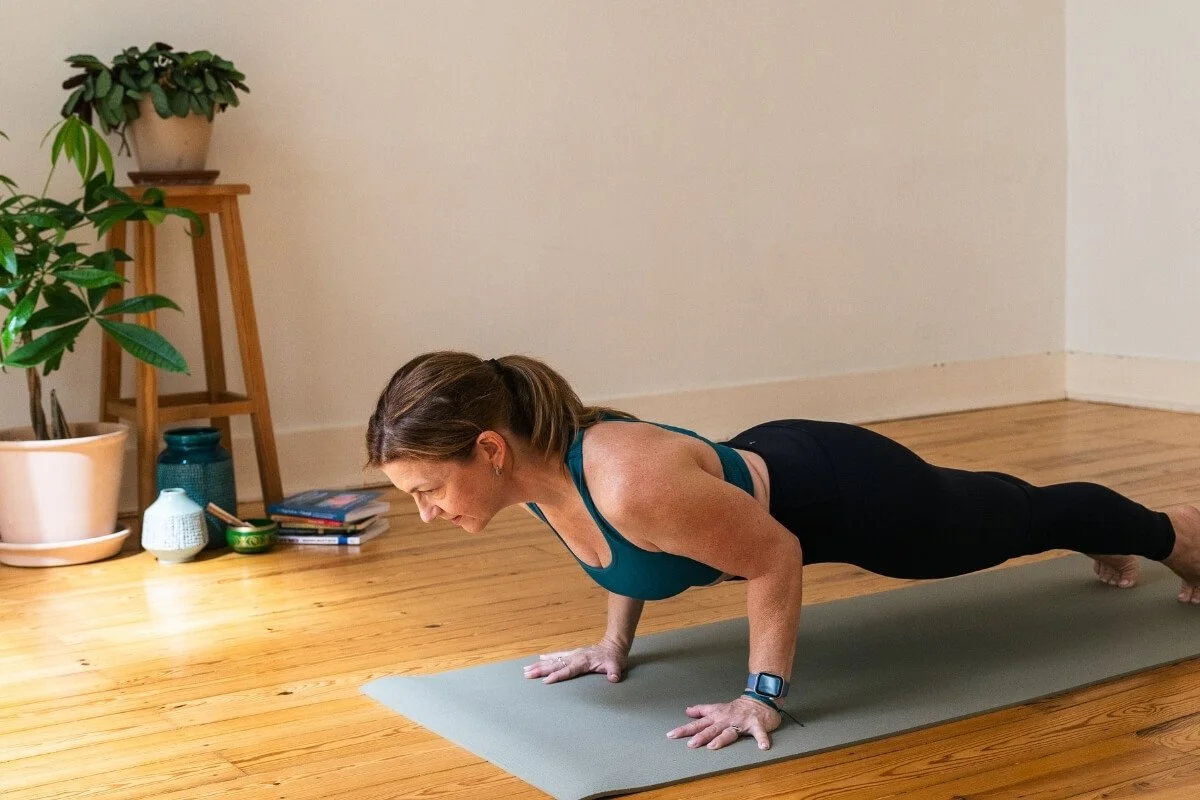
One thing I often see students doing in Chaturanga is dropping their head down lower than their chest. In this article, I will explain why dropping the head will make the posture a lot more challenging.
When you drop your head below your shoulders in Chaturanga, you work against the alignment that makes the posture efficient. Keeping your head in line with your spine takes a small amount of effort from the cervical extensor muscles (the muscles in the back of the neck), and that effort is what makes the posture feel dramatically easier.
In This Article:
What Chaturanga Dandasana actually means
Why dropping your head makes the posture harder
How head alignment connects to spine alignment
How to feel the difference on your mat
Why this matters for you as a yoga teacher
What Chaturanga Dandasana Means
Chatur is Sanskrit for the number 4. Anga means limb. Hence, Chaturanga means 4 limbs. Let this be your reminder to actively use both arms and both legs when you practice this posture.
Danda means staff, while asana means posture. Thus, Dandasana means staff posture. A staff is another word for a stick, as in a walking stick.
All together then, Chaturanga Dandasana means 4 Limb Staff Posture.
Let's focus on this idea of a staff. Of course some sticks can be bent, but a good walking stick is rather straight. And that can be said of a "good" Chaturanga too.
Why Dropping Your Head Makes the Posture Harder
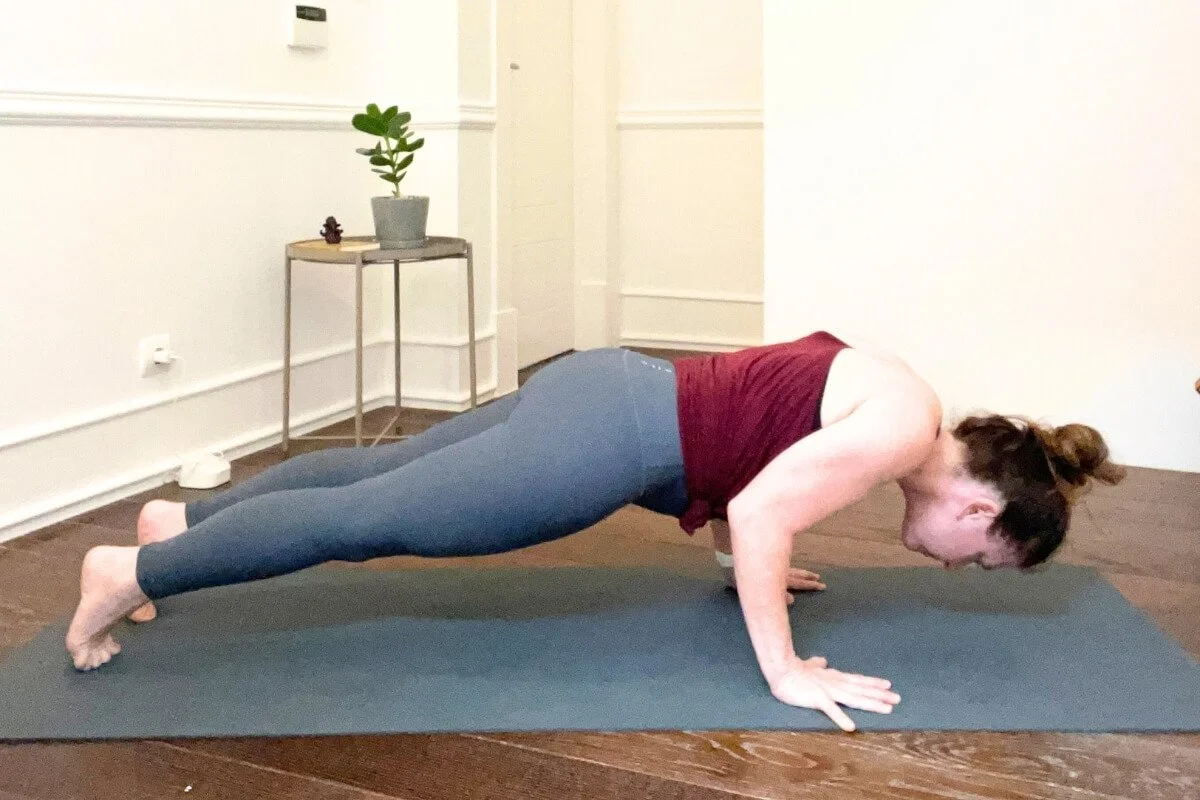
It is very common for students to drop their head down lower than their chest and shoulders during Chaturanga Dandasana. While this may not have any inherent danger, it certainly makes the posture more challenging.
The way to make any posture "easier" is to align the body for efficiency. And in Chaturanga, that means a straight body similar to Tadasana (Mountain Posture).
It does take some muscular action, particularly from the cervical extensor muscles (the muscles in the back of the neck), to keep the head lifted in Chaturanga Dandasana. A little work from those muscles will align the head with the spine. When the spine is well aligned, the body is aligned for efficiency.
Feel the Difference on Your Mat
Rather than getting caught up in the details of physics and biomechanics here, get on your mat and explore.
Come into high plank and lower your head down. Then lower down through Chaturanga Dandasana. For some of you, this will feel like your normal yoga practice. If so, you may be wondering why this posture and transitional movement is still so difficult. For others, you may find it quite challenging to lower down with your head down.
Come back up to high plank, and this time bring your head in line with your spine. Align your whole body like a straight stick. Look forward just in front of your yoga mat to help you align your neck. Reach the top of your head forward, and don't let your head drop down as you lower your whole body down for Chaturanga Dandasana.
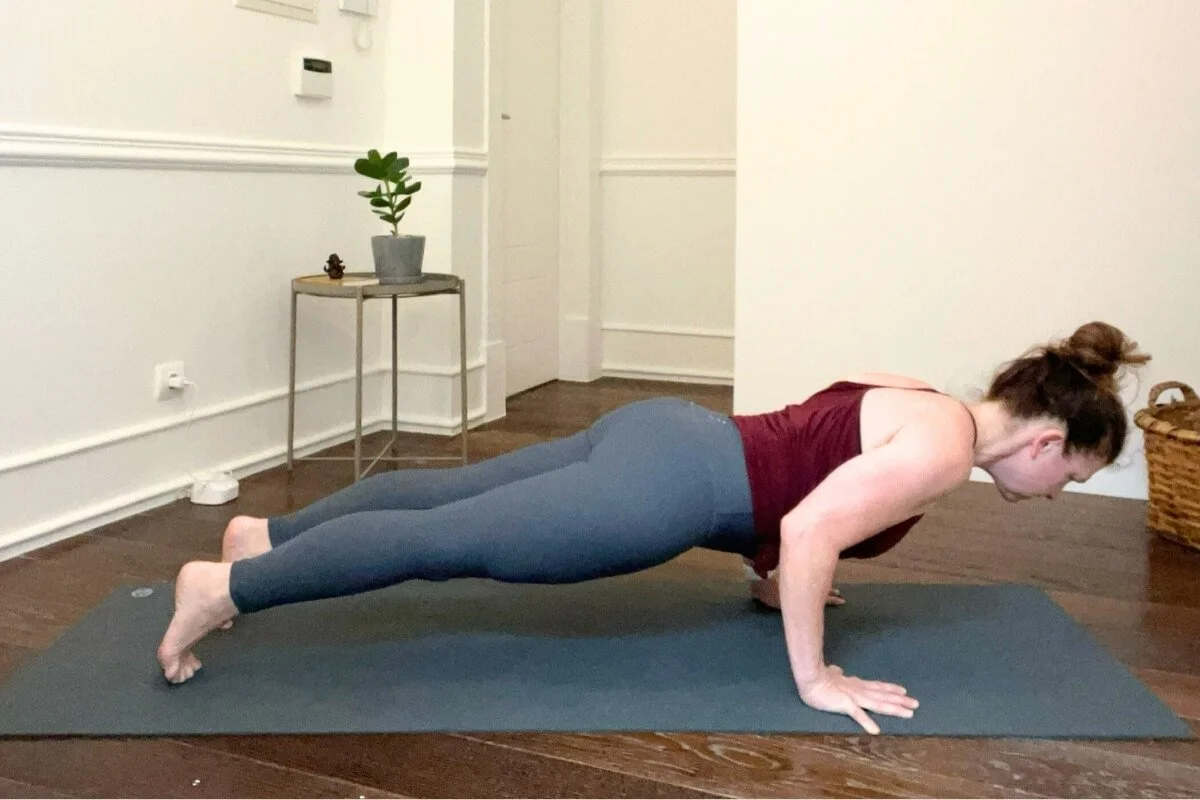
I've taught thousands of students to keep their head in line with their spine and they are consistently happy to report that it makes the posture a lot easier. Yes, it may take focus and discipline and a lot of practice to align the head with the spine consistently. Keep working on it. Ultimately, this will lead to an easier experience of the posture.
Why This Matters for You as a Yoga Teacher
Keep practicing Chaturanga Dandasana with your head in line with your spine. And if you are a yoga teacher, look for the alignment of your students' heads in the posture. Then carry this lesson forward.
Give students the gift of alignment cues and tips that make postures more efficient. They will thank you.
I want yoga students and teachers to better understand alignment in order to have better experiences on the mat and build yoga practices that are sustainable for life. That's why I teach the way I do.
The Bottom Line
Where your head goes in Chaturanga matters. When the head drops below the shoulders, the whole posture becomes heavier and harder to sustain. When the head stays in line with the spine, with the crown reaching forward and the gaze just in front of the mat, the body aligns like a staff and the posture becomes more efficient. A small muscular effort from the cervical extensor muscles (the muscles in the back of the neck) creates a big shift in how the posture feels.
Get Curious! Q&A
Why do so many students drop their head in Chaturanga?
It is usually an unconscious pattern. As the body works to lower down, the head often follows the chest toward the floor. Many students are not aware they are doing it until someone points it out or they watch a video of themselves practicing.
Is it dangerous to drop the head in Chaturanga?
Not inherently. The concern is about efficiency, not danger. When the head drops forward and down, the cervical extensor muscles (the muscles in the back of the neck) stop engaging. Without that engagement, the efficiency of the posture is lost and the whole body has to work harder to hold the position.
Where should I be looking in Chaturanga?
As in all postures, you can play around with setting your drishti, your gaze, at various points. Generally speaking for Chaturanga, I recommend looking at the floor just in front of you. When people are practicing Chaturanga on a yoga mat, I often say to look at the floor just in front of the mat. That gaze helps the crown of the head reach forward and keeps the cervical extensor muscles (the muscles in the back of the neck) engaged, which supports the alignment of the whole posture.
Can I practice this in a modified Chaturanga with my knees down?
Yes. The principle applies whether you are lowering with straight legs or with knees on the mat. Head alignment is the same either way.
Go Deeper with Yoga Anatomy
If you want to see this kind of detail in every posture you teach, the Enlightened Anatomy Course is designed for you. It is built for yoga teachers who want to understand alignment, anatomy, and why the body works the way it does, so you can teach with real clarity and confidence.
Explore the Enlightened Anatomy Course →
About the Author
Dr. Trish Corley is a Doctor of Physical Therapy (Physiotherapy) and yoga teacher trainer with over two decades of clinical experience. She helps yoga teachers learn anatomy, give clear cues, and create classes their students love. Based in Lisbon, Portugal, she leads the Enlightened Anatomy Course, the Elevate Your Impact Mentorship, and the Power to Lead 200-Hour YTT.