
How to Know If Your Yoga Cues Are Working
There's a moment that happens in a lot of yoga classes. You're mid-sequence, calling a posture, moving through the next cue you planned. You're focused. You're delivering. You're present to your own words.
And then you look up.
And you realize you have no idea what just happened in the room.
Did the cue land? Did anyone shift? Did something change? You were so inside the language, so focused on what to say next, that you forgot to look at whether anything moved.
That moment, the moment you realize you've been teaching into a wall, is one of the most clarifying things that can happen to a yoga teacher.
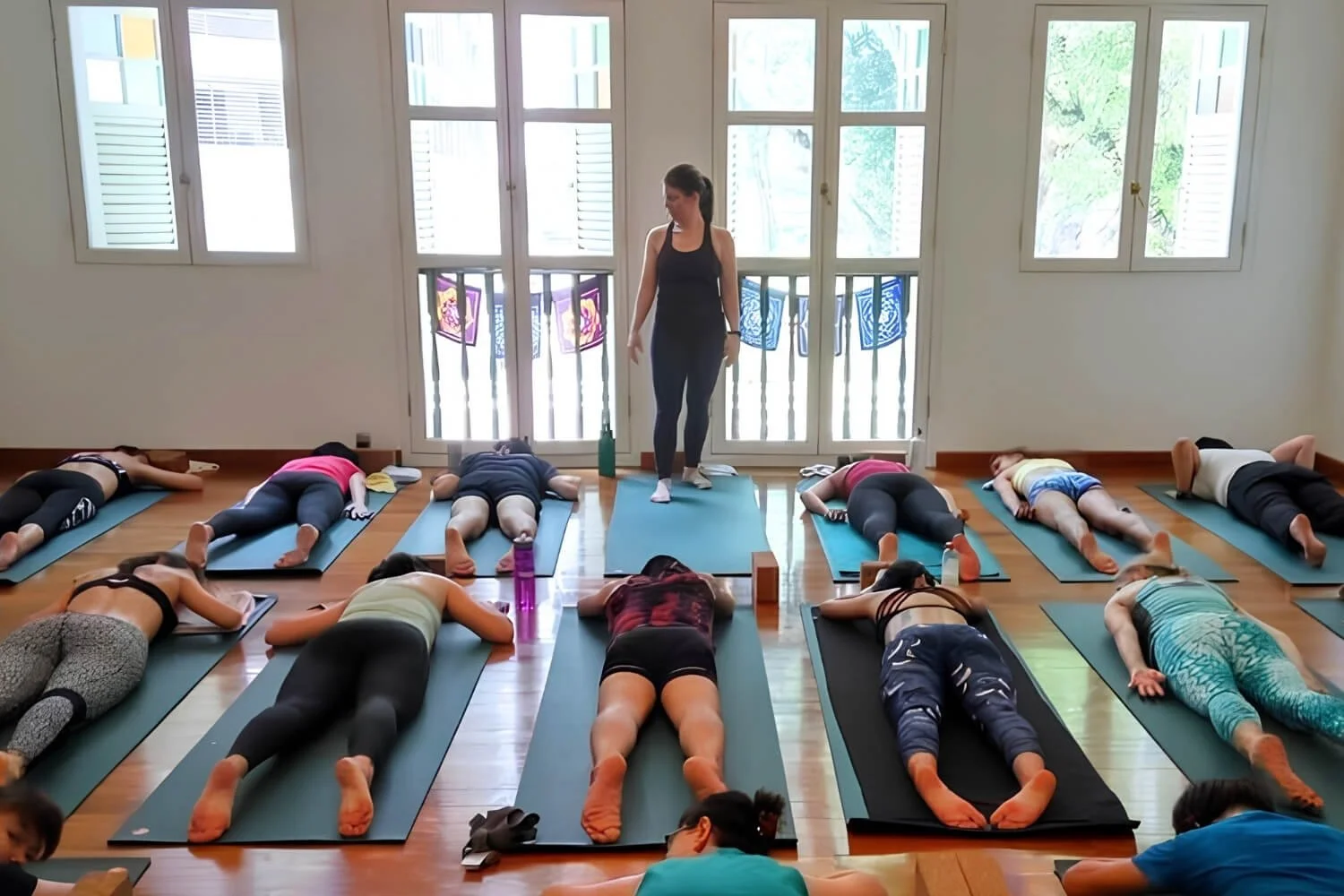
A memory. I was teaching a group yoga class in Singapore, at a studio I taught at regularly. I finished the class feeling completely flat, convinced nothing had landed. Afterwards, two or three students came up and told me it was one of my best classes.
I had been reading the room through expressions. Those flat, inward faces I was interpreting as disengagement were presence. Deep presence. The students who looked blank were the ones most locked in.
Student expressions during practice may tell you something. I've learned though, they don't always tell you what you think they tell you.
So how do you know if your cues are landing?
The only way to know if your yoga cues are working is to look for transformation. And to see transformation, you have to be watching for it.
In This Article:
Why most yoga teachers don't actually know if their cues are landing
The only real measure of cueing impact
What you're watching for (and why it's probably not what you think)
When a cue doesn't land, and what that actually means
A simple starting point for your next class
The Question Most Yoga Teachers Aren't Asking
Here's a question worth sitting with: What actually needs to happen for a cue to make an impact?
Not "what makes a good cue" in theory. Not "what does my training say to say." But in real time, in a real room, what needs to occur for the words you chose to actually do something?
Most teachers, especially early on, are thinking about delivery. The words. The sequence. The tone. The next transition. There's so much to hold that the reception piece, what's actually happening on the mats in front of you, often gets less attention than it deserves.
And without that reception piece, you don't really know.
You might have a feeling. You might have a story running. You might look out and interpret what you see. The problem is that what we see on students' faces during a yoga class is not particularly reliable feedback. That Singapore class taught me that.
So if not faces, then what?
Transformation Is the Only Measure
A cue works when it produces a change.
That change can be physical. A shoulder releases. A foot grounds. A stance widens slightly. Something in the body responds to what you said. That's visible. You can see it.
I will say, knowing what to look for makes all the difference. Much of my work focuses on making this easier for yoga teachers. IMuch of my work focuses on making this easier for yoga teachers. It's why I emphasize cueing bones, not muscles.
The change can also be subtler. A breath that deepens. A body that settles. A shift in the quality of the room's energy. These take more practice to notice, and they count just as much.
If something changed in response to what you said, the cue made an impact. If nothing changed, it didn't, regardless of how well-crafted the words were.
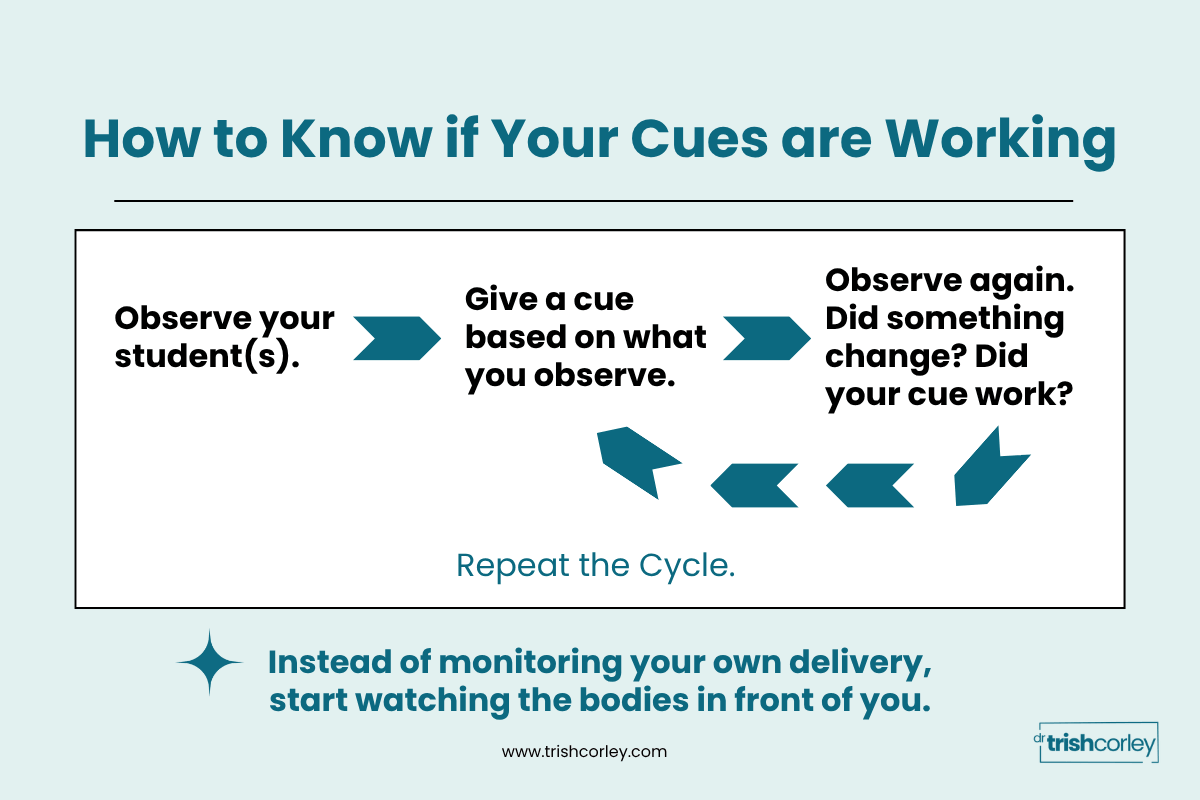
This reframes the whole project of cueing. It moves the focus from what you're saying to what's happening as a result. Instead of monitoring your own delivery, start watching the bodies in front of you.
What Watching Actually Looks Like
Observation isn't the same as scanning the room.
It's looking at a specific person or area of the class, before you cue, and noticing what's actually there. Where are they? What does the posture look like right now? What would be most useful in this moment?
And then, after you offer the cue, looking again. Did something change?
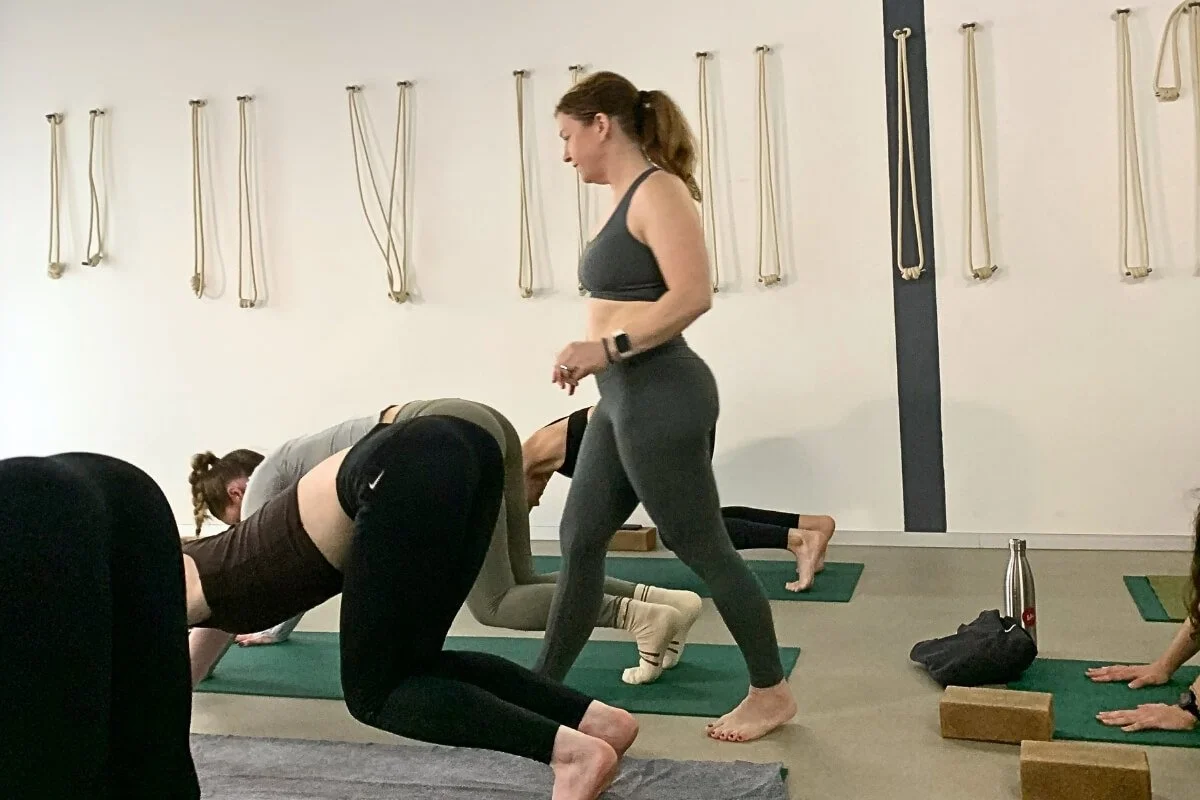
This is a rhythm, not a checklist. Observe. Cue to what you see. Observe again.
When you teach this way, the cues come from the room rather than from a plan. They're responsive rather than delivered. Students often feel the difference, even when they can't name it. The instruction feels like it was meant for them, because it was based on what you actually saw.
Getting off your mat is one of the most underrated moves in yoga teaching. When you're standing still with a clear sightline to the room, you can see what's actually happening. That's where teaching from observation becomes possible.
When a Cue Doesn't Land
Not every cue will reach every person in every class. This is worth saying plainly, because many yoga teachers carry the weight of it unnecessarily.
A cue may not land because the timing was off. Because that particular person was somewhere else for a moment. Because their body isn't ready for it today, or because it will make sense in six months when something else clicks into place.
This came up in a recent Elevate coaching call. The group reflected on what it's like to be a student, hearing the same cue class after class, and then one day having it land completely. The light bulb moment is worth the wait, and as the teacher, you may have planted that seed without ever knowing it.
So when a cue doesn't visibly produce a change: notice, move on. If the same cue consistently doesn't reach the same group over time, that's worth revisiting. One miss is just information.
The Bottom Line
A yoga cue only works if it produces transformation, and the only way to know if transformation happened is to be watching for it. Most yoga teachers focus on delivery and miss the reception. The shift starts with one habit: observe before you cue, and look again after. Let what's actually in the room inform what you say next.
Get Curious! Q&A
How do I actually know if a cue made an impact?
Look for change. Something in the body moved, or the quality of the room shifted. Physical change is the most visible: a body part responds to what you said. Energetic change is subtler: a breath deepens, the room settles. If something changed, the cue landed. If nothing changed, it didn't, and that's information, not failure.
What if I look out and genuinely can't tell if anything changed?
That happens, especially early on. Start with one person per posture. Choose someone with a clear sightline, look at them before you cue, give one specific instruction, and look again. One person, one cue, one check. That's a sustainable starting point.
Is it possible that flat, unexpressive faces mean my class is going well?
Yes. When students are deeply present in their bodies, they often go inward, and the outward expression goes quiet. This can look like disengagement from the front of the room. It frequently means the opposite. Reading faces as your primary feedback source is less reliable than it feels.
How do I get better at observing while managing everything else in the room?
Start with one deliberate pause per posture. Call the name of the posture. Stop. Let people arrive. Look before you say anything else. That pause, even two or three seconds, is where observation begins. The rest builds from there.
What do I do when the same cue keeps not landing with the same group?
That pattern is worth paying attention to. Try a different angle, a different body part reference, or a different sensory entry point. If the words aren't producing change consistently, the words may need to change. The goal is always transformation, not loyalty to a particular phrase.
Go Deeper with your understanding of cueing!
Observation tells you that something needs to change. Knowing anatomy helps you understand what you're seeing, and gives you language grounded in how the body actually works.
If you're ready to start cueing from what you observe rather than from a script, join me for my next Free Training Cueing for Yoga Teachers. l will break down common cues and show you why they don't land and what to say instead.
Free Training: Cueing for Yoga Teachers →
About the Author
Dr. Trish Corley is a Doctor of Physical Therapy (Physiotherapy) and yoga teacher trainer with over two decades of clinical experience. She helps yoga teachers learn anatomy, give clear cues, and create classes their students love. Based in Lisbon, Portugal, she leads the Enlightened Anatomy Course, the Elevate Your Impact Mentorship, and the Power to Lead 200-Hour YTT.