
Yoga Teacher Limiting Beliefs: The 3 Most Common
She had been teaching for two years.
Small classes at a community center, a handful of regulars who loved her. When I asked what was holding her back from stepping into a bigger teaching role, her answer came instantly.
"I think I just need more training."
Here's the thing: sometimes that's true. If I wanted to lead a full chanting training tomorrow, I'd need to study. I know a handful of basic chants, and that's the honest edge of what I can teach with integrity right now. That's not a limiting belief. That's self-awareness.
The teacher I was mentoring, though? She had a 200-hour training, two years of consistent teaching, and students who kept coming back. Her belief wasn't rooted in a real gap. It was rooted in not trusting what she already knew.
That distinction, between honest self-awareness and a false belief dressed up as wisdom, is at the heart of what holds most yoga teachers back. Limiting beliefs feel responsible. They feel like discernment. They sound so reasonable that most teachers never stop to question whether they're actually true.
Yoga teacher limiting beliefs are the single most common thing standing between a capable teacher and a fully confident one. Unlike anatomy or sequencing, they don't resolve by adding more knowledge. They dissolve when you learn to recognize them for what they are.

In This Article:
What limiting beliefs actually are, and why yoga gives us the perfect lens to examine them
The 3 most common limiting beliefs yoga teachers hold
Why transformation as a teacher comes from removing, not adding
What it looks like to teach from a clear, settled mind
What Limiting Beliefs Actually Are
A limiting belief isn't a fact. It's a thought you've been thinking so consistently that it starts to feel like one.
In yoga philosophy, these are vrittis — fluctuations of the mind. Thoughts that arise, feel convincing, and shape how we show up. If you want to go deeper on how doubt specifically shows up as a vritti for yoga teachers, this post on yoga teacher self-doubt is a good place to start.
Yoga Sutra 1.2 describes the entire practice of yoga as the stilling of these fluctuations: yogas chitta vritti nirodha. The practice isn't about eliminating thought. It's about learning to witness thought without being swept away by it.
For yoga teachers, this matters enormously. The beliefs you hold about your teaching, whether you're ready, whether you're enough, whether you look the part, directly shape every class you walk into. They filter how you receive feedback, how you respond to a challenging student, and how much of yourself you're willing to bring into the room.
The good news: you already have the tools to work with them. You've been practicing this your whole yoga life.
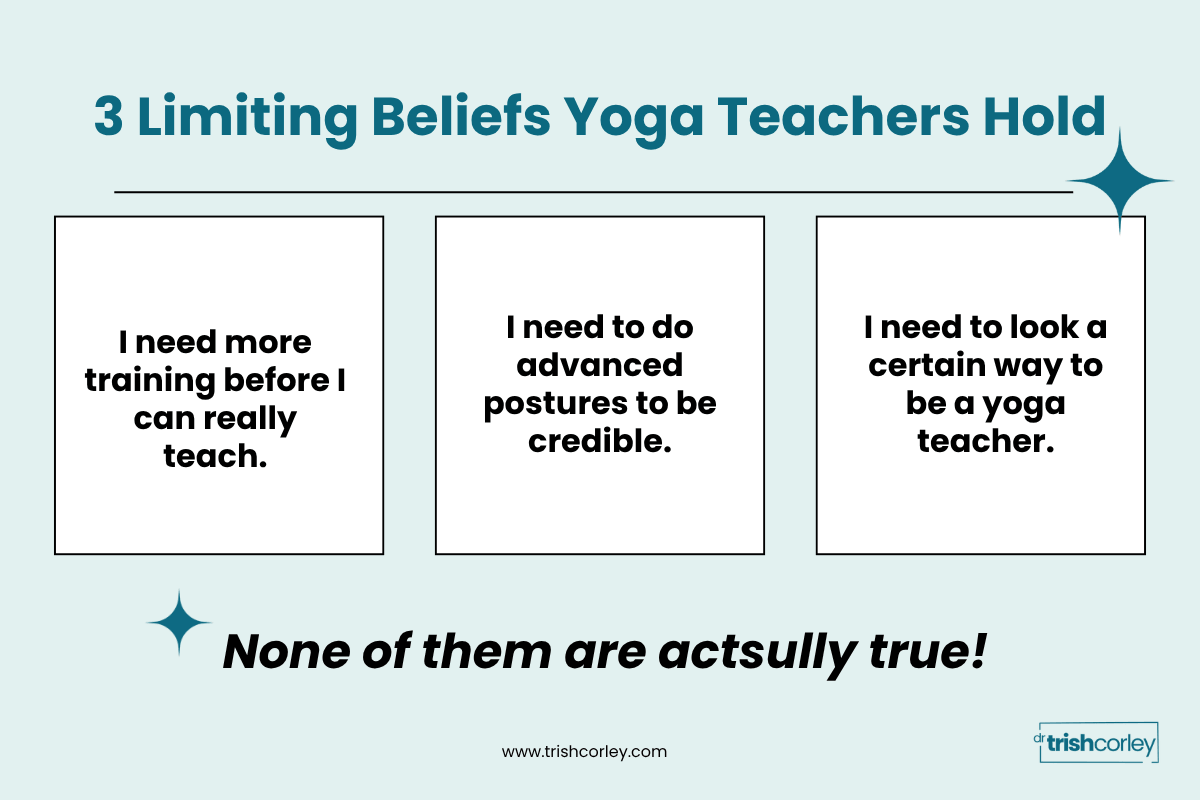
Belief #1: I Need More Training Before I Can Really Teach
This is the most common one. And it sounds responsible, which is exactly what makes it so sticky.
As we established in the opening, there's a real difference between a genuine knowledge gap and a limiting belief. Not feeling ready to lead a chanting training when you've only studied a handful of basic chants? That's discernment. Not feeling ready to teach a vinyasa class after a 200-hour training because you're worried you're not good enough? That's a limiting belief.
One is wisdom. The other is doubt wearing wisdom's clothes.
If you've completed a yoga teacher training, you have enough knowledge to teach. Not everything, not all styles, not every population. Within what you know, though, you are ready. The work isn't to accumulate more knowledge before you begin. It's to learn to trust the knowledge you already have.
Belief #2: I Need to Be Able to Do Advanced Postures to Be a Credible Teacher
This one runs deep, especially in communities that celebrate physical achievement.
Some of the most impactful yoga teachers I've practiced with over the years cannot hold a handstand. What they do is teach from themselves, from their own experience, their genuine presence, their capacity to see and respond to the students in front of them.
The idea that students will only take you seriously if your practice looks a certain way is a false belief. Students come back to teachers who make them feel seen. Not to teachers who can do the most impressive things on a mat.
There's also a practical teaching truth here: a teacher who is deeply connected to their own experience and can communicate it clearly will create a more meaningful class than a teacher with an impressive physical practice and no ability to translate it into teaching. The posture is the vehicle. The teaching is the destination.
Belief #3: I Need to Look a Certain Way to Be a Yoga Teacher
The wellness industry has spent decades projecting a very specific image of what a yoga teacher looks like. Many teachers absorb that image, consciously or not, and measure themselves against it.
Here's what that belief actually costs you: your authenticity.
When you try to look like someone else, in your physical appearance, your language, the way you structure a class, the personality you project, you create more mental noise, not less. More vrittis, not fewer. Your students will feel the gap between who you're presenting and who you actually are, even if they can't name it.
The only teacher you can be with full integrity is yourself. That's not a limitation. For the students who are meant to be in your room, it's your most compelling quality.
Why Transformation Comes from Removing, Not Adding
One of my teachers, Baron Baptiste, says that transformation comes not by adding things on, but by removing what didn't belong in the first place.
This is the reframe that shifts everything for teachers who have been accumulating certifications, trainings, and external markers of credibility in an attempt to feel ready.
The practical tools matter. Clear cueing, anatomy knowledge, effective sequencing — there's real value in developing them, and that work is worth doing. The deeper shift, though, the one that changes how you show up every single time you teach, comes from letting go of the beliefs that were never true to begin with.
The yoga practice that supports this is svadhyaya: self-study. One of Patanjali's niyamas, svadhyaya is the practice of turning your attention inward to examine your own habits, beliefs, and thought patterns, from genuine curiosity rather than self-criticism. When you can look clearly at a belief, recognize it as a thought rather than a fact, and see that it isn't actually true, it loses its grip.
That's not a personality trait. It's a skill. And it starts with knowing which beliefs you're actually carrying.
The Bottom Line
Yoga teacher limiting beliefs are not a sign of weakness — they're a sign you're thinking seriously about your teaching. The shift happens when you learn to examine them with honest eyes, recognize what's actually true, and give yourself permission to step forward without waiting for the doubt to disappear first.
Get Curious! Q&A
What are the most common limiting beliefs yoga teachers hold?
The three that surface most often are: I need more training before I can really teach, I need to be able to do advanced postures, and I need to look a certain way to be taken seriously. All three feel reasonable on the surface. None of them are actually true. They're thoughts generated by the mind, not facts about your readiness.
How do I know if it's a real knowledge gap or a limiting belief?
A genuine gap sounds like: "I want to teach pranayama and I haven't studied it deeply yet." A limiting belief sounds like: "I've done my training, I know how to lead a class, I'm just not sure I'm good enough yet." The first is discernment. The second is doubt. Learning to tell them apart is itself part of the practice.
Do limiting beliefs affect experienced teachers too, or just newer ones?
They affect teachers at every stage — the content just shifts. A newer teacher may hold "I need more training." An experienced teacher may hold "I need to be teaching bigger rooms by now" or "other teachers at my level are further ahead." The pattern of measuring yourself against an external standard, rather than your actual impact, can show up at any point in a teaching career.
What is svadhyaya and how does it apply to teaching yoga?
Svadhyaya is one of yoga's niyamas, the personal observances from Patanjali's eight-limbed path. It translates as self-study: the practice of turning your attention inward to examine your habits, patterns, and beliefs. Applied to teaching, it means regularly looking not just at what you teach, but at what you believe about your capacity to teach. It's one of the most practical, yoga-rooted tools for building genuine confidence in the classroom.
How do I start examining my own limiting beliefs as a yoga teacher?
Begin with noticing. The next time you catch yourself saying "I'm not ready because..." — pause. Ask whether that belief is genuinely true, or whether it's a thought you've been repeating so often it feels true. That moment of noticing is where the practice begins. From there, the work is building a consistent practice of honest self-inquiry, which is exactly what the Mindset pillar inside Elevate Your Impact is designed to support.
Go Deeper with your confidence as a yoga teacher.
If this resonated, Elevate Your Impact was built for you!
The Mindset pillar is the first of six inside the mentorship. It goes deep into the specific beliefs yoga teachers carry, the yoga-rooted practices for examining and releasing them, and how to build a teaching presence grounded in genuine clarity.
Discover Elevate Your Impact →
About the Author
Dr. Trish Corley is a Doctor of Physical Therapy (Physiotherapy) and yoga teacher trainer with over two decades of clinical experience. She helps yoga teachers learn anatomy, give clear cues, and create classes their students love. Based in Lisbon, Portugal, she leads the Enlightened Anatomy Course, the Elevate Your Impact Mentorship, and the Power to Lead 200-Hour YTT.