
There's a question I thought I knew the answer to for a long time. Then I showed up at a studio in Houston and discovered they did it completely differently.
When you're in Downward Facing Dog and about to jump or float forward, do you inhale or exhale? What do you cue when you're teaching?
I got curious and polled yoga teachers. Here's what came back:
29% inhale and float forward
55% exhale and float forward
17% hold the breath
I'm in the 55%. And I have an anatomical reason for it.
The breath cues you give in yoga aren't just about flow or rhythm. They directly influence your students' core stability, and that changes everything about how they move.
In This Article:
The anatomy of breathing and how the diaphragm moves
How inhales and exhales affect your core muscles
Why exhaling to float forward makes anatomical sense
When holding the breath is also a valid option
The Anatomy of Breathing
Breathing exists to get oxygenated air into your lungs. Once there, oxygen diffuses into the blood and circulates to wherever your body needs it. But how does air actually get in?
The volume of your thoracic cavity changes, and air flows in and out in response. Several muscles are involved in that process, and the diaphragm does most of the work.
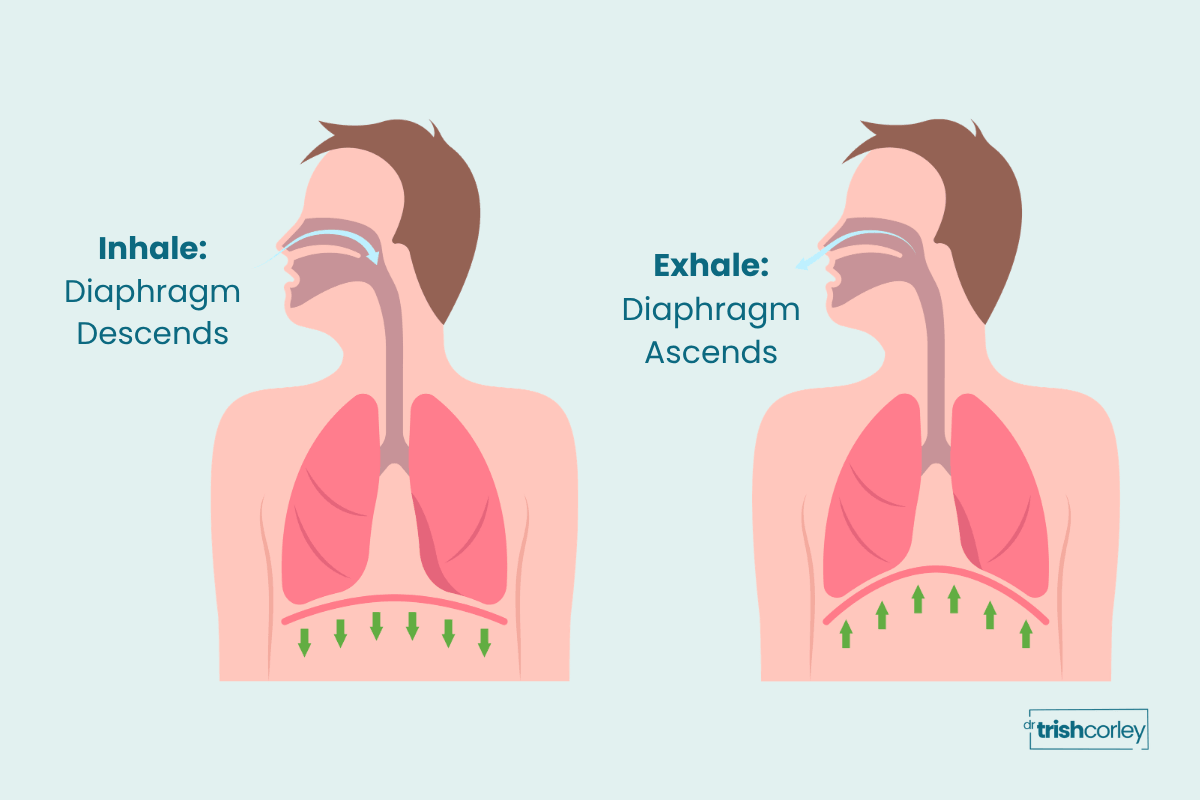
The diaphragm is a dome-shaped muscle sitting at the base of your ribcage, separating your thoracic cavity (where your lungs and heart live) from your abdominal cavity. As you inhale, it contracts and moves downward, creating space for your lungs to expand and fill with air. As you exhale, it relaxes and moves upward, helping push air back out.
That continuous movement is the foundation of efficient breathing and it has a direct impact on stability in your yoga postures.
The Diaphragm Does Not Work Alone
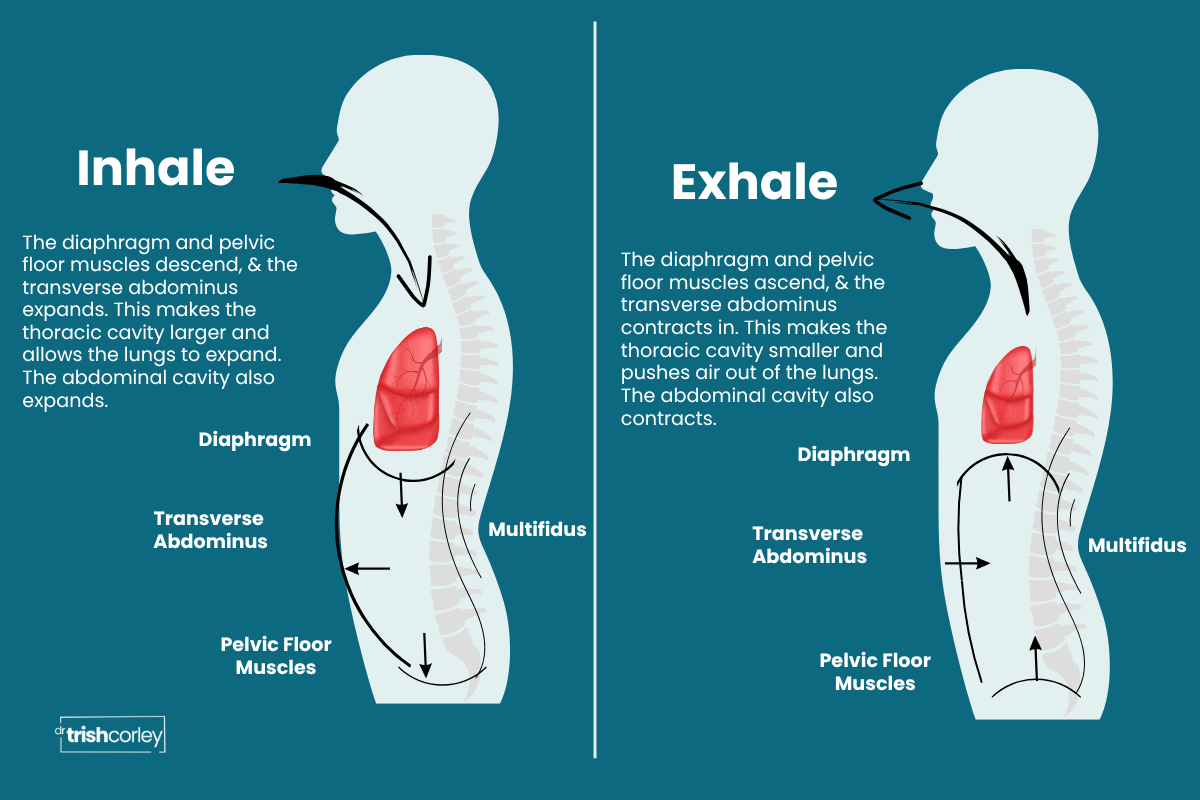
The diaphragm is connected to a larger system. I tend to teach the core as a pressure system made up of four primary muscles: the diaphragm, the pelvic floor, the transverse abdominus, and the multifidus. These muscles work together to regulate pressure inside the trunk and provide support to the spine and abdominal organs.
The degree of support they provide scales with the demand of the movement. Picking a piece of paper off the floor? You probably won't notice your core engaging at all. Picking up a heavy box? You'll feel it. The core muscles increase their activity in response to load and challenge.
So what does this have to do with your breath cues in yoga?
Every time you say inhale or exhale in class, you are influencing what your students' core muscles are doing. Here is what that looks like.
On an inhale, the diaphragm descends and the abdomen gently expands. The pelvic floor moves in the same direction, also descending. The core as a whole expands and has less tone.
On an exhale, the diaphragm ascends and the abdomen draws inward. The pelvic floor lifts in the same direction. The core contracts and creates more support for the spine.
If you've ever wondered why 'engage your core' doesn't work as a cue, this is exactly why.
Why Exhale? The Anatomy Behind This Breath Cue
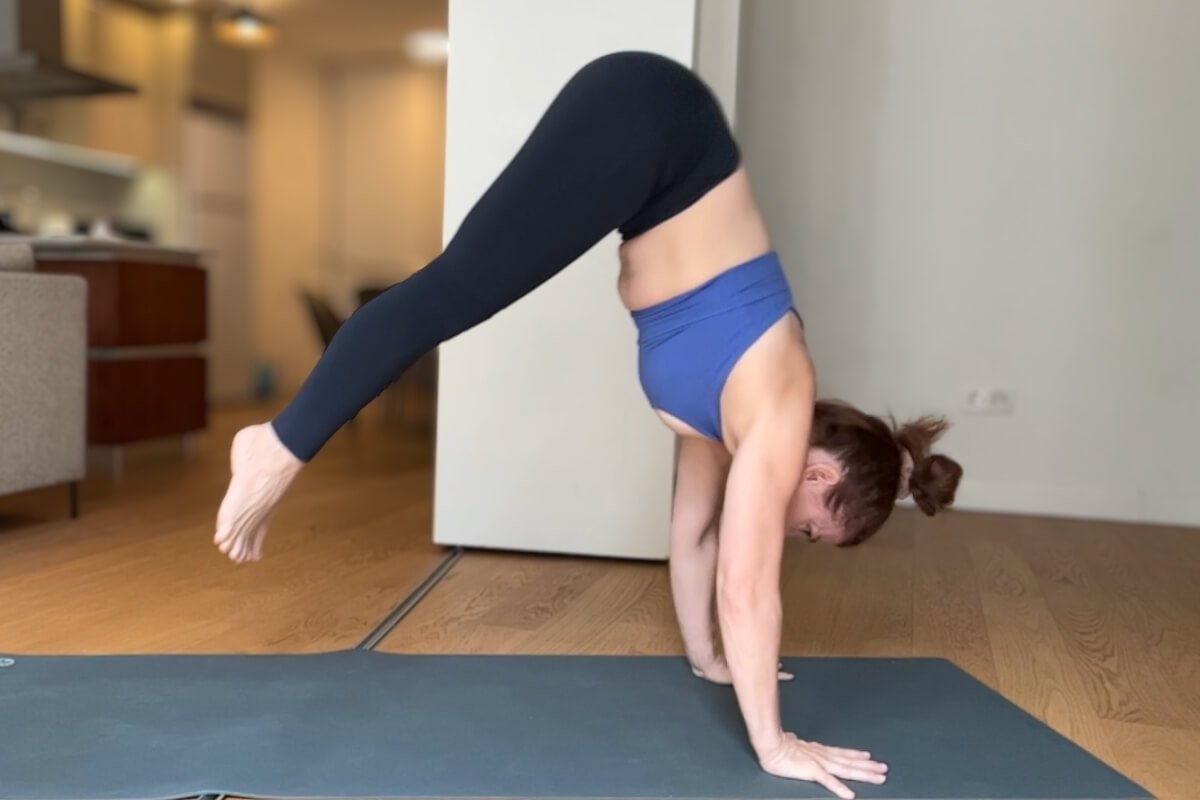
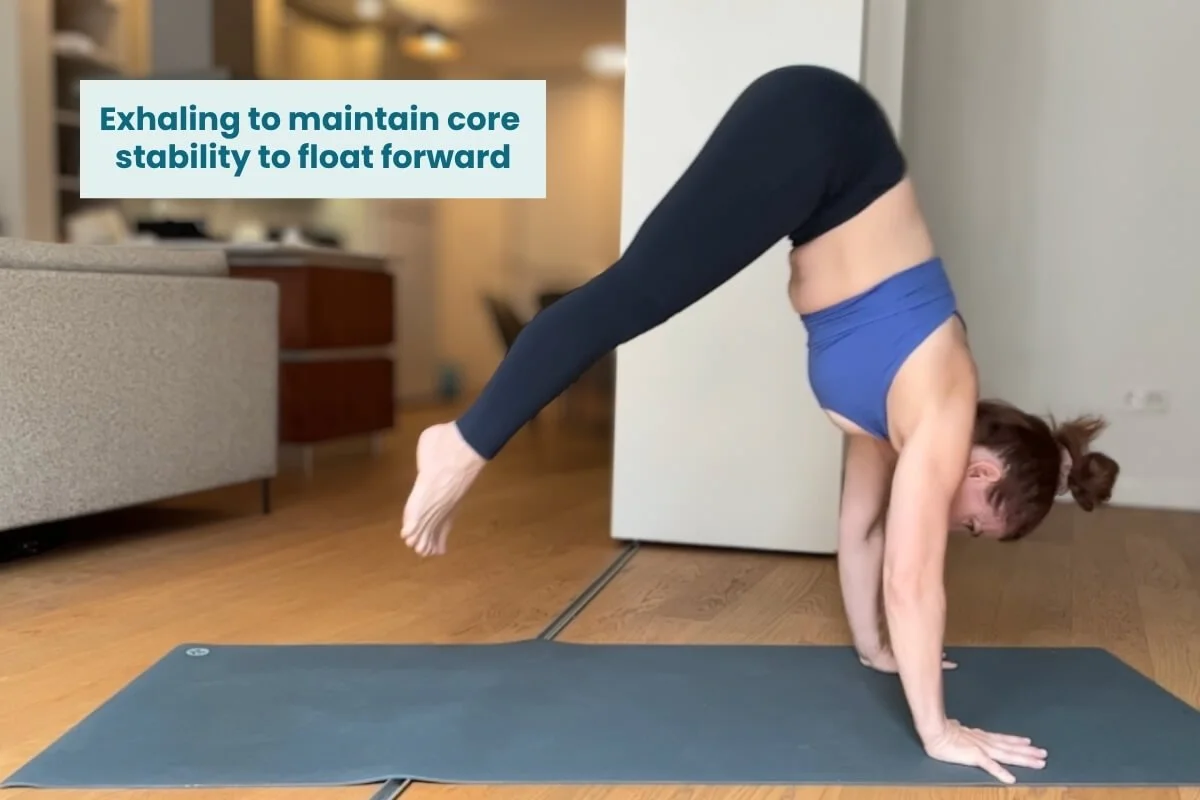
Floating or jumping forward from Downward Facing Dog is one of the more challenging transitions in a yoga practice. If you watch your students attempt it, you will likely see a range of results. Some float forward with ease. Many land heavily or struggle to get their feet close to their hands.
The breath cue you give matters more than you might think.
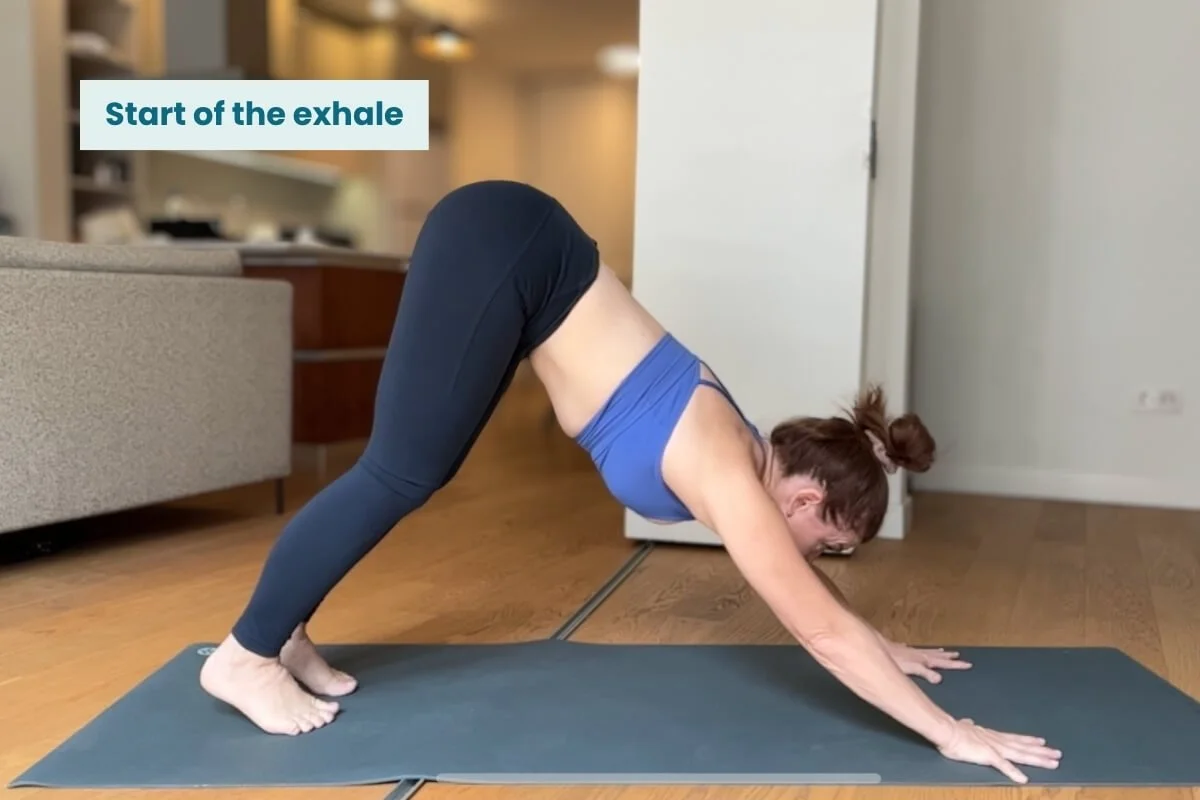
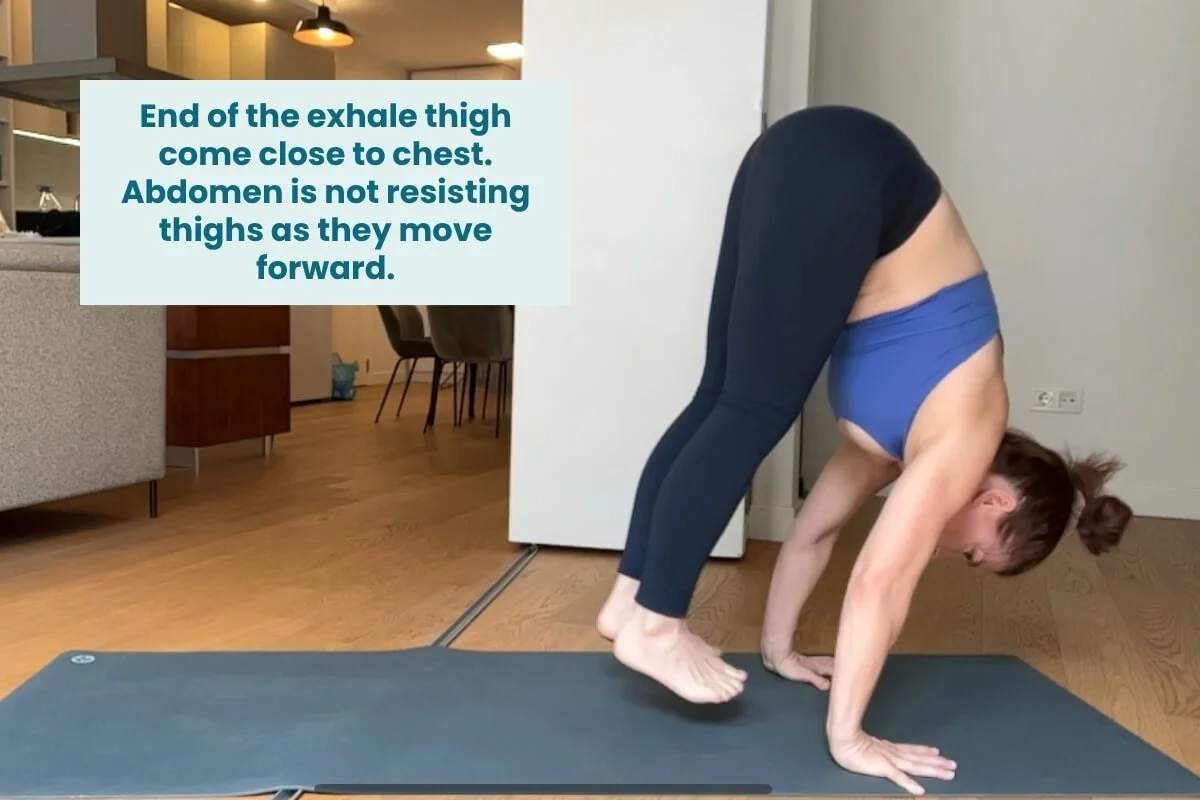
When you cue an exhale, your students' core muscles are in their most supportive state. The diaphragm ascends, the abdomen draws in, and the pelvic floor lifts. That contraction creates the internal support needed to control the transition and bring the body forward with more ease.
Cueing exhale to float forward is working with the natural mechanics of the breath, not against them.
When you cue an inhale, the opposite is happening. The diaphragm descends, the abdomen expands, and the core has less tone. That expansion also creates physical resistance as the thighs and abdomen try to come closer together in the landing position. The transition becomes harder, not easier. If you are building your Downward Dog foundation, how you set up the posture affects how available this transition will feel.
What About Holding the Breath?
Holding the breath is also a valid option, with one important condition: exhale first.
If you or your students jump or float forward after a full exhale and before the next inhale, the core is still in its contracted, supportive state. That window between the exhale and the next inhale can actually be a powerful moment to move.
In my own practice, I tend to complete most of my exhale before my feet leave the mat. Some people exhale fully before moving at all. Neither is wrong. In my experience teaching, it takes some refinement to get there. The coordination of breath and movement is a skill, and it develops over time.
So if a student is holding their breath and floating forward, the question worth asking is: are they holding after the exhale, or are they holding after the inhale? The answer changes everything.
The Bottom Line
The breath cues you give in yoga are not just about keeping your students breathing or creating rhythm in your sequence. They influence core muscle engagement, and that has a real impact on how your students experience transitions, stability, and ease of movement.
Exhaling to float forward works with the anatomy. It gives your students the best chance of a controlled, supported transition. If they are holding the breath, make sure they are holding after the exhale, not before it.
Your breath cues are teaching tools. Use them with intention. Learn more about cueing here.
Get Curious! Q&A
Do I have to exhale to float forward in yoga?
You don't have to, and plenty of teachers cue it differently. The anatomical case for exhaling is that your core is in its most supportive state at the end of an exhale, which makes the transition more controlled and accessible for most students. If you or your students find a different approach works, that is worth paying attention to. Context always matters.
What if my students can't float forward no matter what breath cue I use?
The breath is one piece of a larger puzzle. Floating forward draws on core strength, hip flexor engagement, body awareness, and the ability to shift weight forward over your hands. Starting with the exhale gives your students the best mechanical foundation for the transition. From there it is worth looking at what else might be limiting them. Where is the movement breaking down? Are they shifting their weight forward enough? Is there tension in the hips? The breath cue opens the door. Observation and understanding of the biomechanics helps you walk through it with them.
Why does the exhale help with core engagement in yoga?
During an exhale, the diaphragm ascends and the abdominal muscles draw inward. The pelvic floor lifts in the same direction. That coordinated contraction creates more internal support for the spine, which is exactly what you need during a challenging transition like floating forward.
Is it okay to hold the breath when jumping forward in yoga?
Yes, as long as the breath hold comes after the exhale, not before it. Holding after a full exhale keeps the core in its contracted state, which still supports the transition. Holding after an inhale has the opposite effect.
Should I always cue the exhale on challenging transitions in yoga?
In general, yes. Transitions tend to be more demanding than holding a posture, and the exhale gives students more core support for those moments. It is a useful default. As with everything in yoga, observe what is actually happening with your students and adjust from there.
Go deeper with your understanding of breath, anatomy, and cueing.
If you want to give cues that actually make sense to you and to your students, understanding the anatomy behind them is where it starts. The Cue with Confidence guide is a free resource that introduces you to anatomy-informed cueing through the foundation of the Balanced Posture Alignment framework.
Download the free Cue with Confidence Guide →
About the Author
Dr. Trish Corley is a Doctor of Physical Therapy (Physiotherapy) and yoga teacher trainer with over two decades of clinical experience. She helps yoga teachers learn anatomy, give clear cues, and create classes their students love. Based in Lisbon, Portugal, she leads the Enlightened Anatomy Course, the Elevate Your Impact Mentorship, and the Power to Lead 200-Hour YTT.